Torch Flashbacks Sean Waltman, pt. 2: "When Jericho came to the WWF, he didn't get it yet." (10-12-02)
Nov 15, 2007 - 6:56:39 PM
PLEASE TAKE A MOMENT TO BOOKMARK US & VISIT US DAILY
Torch Talk with Sean Waltman
Original Headline: "When Jericho came to the WWF, he didn't get it yet."
Originally Published: October 12, 2002
Torch Newsletter #726
The following is part two of a multi-part "Torch Talk" with Sean Waltman, a/k/a X-Pac. The interview was conducted on Sept. 30, 2002.
Wade Keller: The WWF couldn't find anything for Jerry Lynn because he was too bland or didn't have the right look. They sure have made good use of Jim Ross, who has Bell's Palsy, can't quite smile, has a Southern accent, and isn't exactly the attractive-type face that Vince McMahon wants on his programs. Yes, he has been a very important part of the WWF and one of the MVPs of the entire company at times over the last few years.
Sean Waltman: Yes, exactly. There's a guy right there, who a lot of people can say what they want about, but he works harder than anybody in that company. And he doesn't get nearly the reward that he should for the amount of work that he does. I know all of the responsibilities that he has. If I told you, you wouldn't believe it. I'm sure you know.
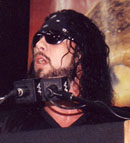
Sean Waltman [photo by Wade Keller (c) PWTorch]
Keller: He's an example of someone who had enough strength in a couple of areas as an on-air person and Jerry Lynn obviously has strengths that could overcome the negatives had they bothered to try.
Waltman: Sorry he's not like one of the beautiful people, so to speak. What are you going to have, everybody is a perfect ten on your show? That's not reality, man.
Keller: ECW always had the mentality that they were a bunch of misfits and rejects and people who were fighting for an opportunity. That's kind of what defined how good the promotion was when it was really good, and it was really good a lot of the time. Did you sense a similar attitude backstage at NWA-TNA PPVs that "we're a bunch of misfits who are out to prove the establishment wrong?"
Waltman: Not so much as what you're talking about with the ECW guys, but in a certain sense, yes. Not that they are misfits, but that they are being overlooked. They are wanting their opportunity, that's all they're asking for, any of these guys. And some of them aren't going to make it. Some of them aren't nearly as good as they think they are.
Keller: Like who?
Waltman: I don't really...
Keller: I don't really expect you to answer that. That would be unfair to expect you to...
Waltman: If I could think of someone as an example off the top of my head, I would tell you...
Keller: But you've been in the locker room, it's not this depressing place where, oh my God, we're here, it would be so nice to be in WWE, or it would be so nice if WCW were still around. Is there a sense that this is a fun place to be and we're excited that we can showcase ourselves?
Waltman: Yeah, let me tell you, the feeling I get from those guys, from the crew they have down there. They're not there with the attitude that, okay, I'm going to come on here and hopefully Vince will see me on this show and then I can get to the WWF. That's not the feeling I get from any of these guys. They're there and are trying to make something for themselves. They're trying to be a part of building something good. I really don't believe most of the guys are there with the sole motive of trying to use it as a stepping stone to the WWF, I really don't. There are a number of guys that I'm thinking of that I think are phenomenal talents in the raw, they're like an un-cut diamond. I think Elix Skipper is a phenomenal athlete and does some really good stuff. God, there are some guys there whose names I can't even remember but have a lot of potential.
Keller: Have you seen a lot of guys in TNA who are indy wrestlers who wrestle in a way that needs to be overhauled in order to be part of a large or national promotion as opposed to an indy show where you're just trying to get a pop out of a 125 people who are close up?
Waltman: Yes, there are a bunch of those, too.
Keller: That doesn't mean that they can't be taught or can't adapt.
Waltman: No, definitely not, because I was one of those guys before. There are some guys who you look at and you see "indy wrestler." I'm not a big fan of guys wearing something other than wrestling trunks and wrestling tights to wrestle. If you have a bunch of guys wearing shorts and sh-- in the ring it just looks like a bunch of backyard wrestlers. A lot of them don't realize how far they have to go as far as what they're doing in the ring. A lot of them are so enthusiastic and they have a lot of ideas. It's really cool to feed off of that, but in a tactful way, you kind of have to mold the ideas they're giving you and show them why they fit here better, or why you can't do that in the beginning of a match, a lot of things.
Keller: What is the much talked about "WWF style" that Chris Jericho purportedly did not have when he got there, and people talk about, and other people kind of mock by saying, "Since when does the WWF have the universally ideal style?" What does it mean when people say that you have to "learn WWF style"?
Waltman: It's not WWF style, it's main event style.
Keller: What does that mean? Does it mean dumbing down your matches so you don't get hurt? Seriously, that's what some people think it means. What does it mean to work "main event style?"
Waltman: It's almost hard to explain it. It's just doing things and... You have to be able to know what the people want or how they're going to react to certain things at a certain time. When Chris Jericho came to the WWF, he didn't get it yet. He didn't even realize that he didn't get it, and it was very frustrating for him at the time. He had a hard time when he got there. I worked with him. And it felt really good one day when he came and thanked me. I know he doesn't go on the internet and go, "Oh, thanks to Sean Waltman for doing this or that." I don't want him to, I don't care. He pulled me aside one day after he had a f---ing awesome match with somebody and said, "I want to thank you for what you did to help me learn how to do things." I'm not the only one who helped him, and he helped me too in a lot of ways. But that made me feel good, Wade, because I don't give a f--- if all of these people on these message boards are leaving comments saying that I'm the sh--s, and I'm not worthy of having a job, or whatever. There's a lot of sh-- that these people say about me. You know what? When somebody like Jericho says that to me, that means so f---ing much that you wouldn't even believe me.
Keller: What do you say to a wrestling fan who watched Jericho in WCW and thought, "This guy is underutilized, he's a great worker, I can't wait until he gets to the WWF"? Then he gets there and all you hear out of the WWF locker room is that Jericho needs to learn to wrestle. What do you tell the wrestling fan who says, "Wait a second, I loved his work in WCW. What do you mean he has to learn to work?" How do you make that something a fan can understand when you say that Jericho needs to learn how to work a "main event style" when they already liked what he was doing?
Waltman: They as in the people...
Keller: Yes, just the average fan who was popping for Jericho in WCW and really thought he was cool and had good matches and was an exciting worker who had these good matches with Dean Malenko and Chris Benoit and Rey Jr. Then he gets to the WWF and all they hear is, "Jericho doesn't know how to work, that's why he's not getting pushed right now."
Waltman: Do you really think that that was the average fan?
Keller: I don't know. What do you say to the fan who said that, however many there were? Or to the wrestling reporters who didn't get it and kept saying it was all politics holding Jericho back?
Waltman: I say I agree 100 percent that the guy was underutilized. I agree 100 percent that the guy is a fantastic talent. But you have to adjust.
Keller: To what?
Waltman: You have to adjust to the way that the majority of your main event talent works. And they are main event talent, Wade, for a reason. Not because somebody has a hard-on for them or they're somebody's friend and they decided to give them a push. You can't f---in' make the masses like somebody. You can't force them to like somebody. That's a fact. At one time you probably could.
Keller: To a degree, but Rick Martel wasn't selling out when the AWA shoved him down people's throats.
Waltman: Right, you can't, so all of these people, the so-called average fan that is really such a small minority of the people who are actually wrestling fans. Those people who they say suck, they don't suck. They don't do moonsaults and topes and planchas and a million different phenomenal moves, but they know what to do and when to do it. It's really simple. It's like a song, Wade. It's really hard to follow a speed metal fan. Yngwie Malmsteen, which might be a really obscure reference to make but he's a guitar player. Guys like that are phenomenal guitar players, but it's just busy guitar playing. You know what? AC/DC's music is very, very simple, and that's what gets the masses and it's easy to follow. I don't know how else to describe it. Don't complicate things for the fans. Don't set your match up to f---in' entertain yourself, set your match up to entertain the people. And that's where a lot of the guys are going wrong. Because that's what entertains you... You have to separate yourself from the people, as far as that goes, and it doesn't happen a lot of times.
Keller: Give us something, if you can, more tangible to the person out there... And I use Chris Jericho as just one example of many. What, for instance, is something that Jericho did that he had to stop doing, and what's something he started doing when he really did learn what being main event was about? And if you think you've already answered it, tell me that. But if there is something specific you can create a picture for me of...
Waltman: It's a hard question to answer for somebody that's reading this interview. I'm kind of getting a little frustrated with myself. Part of it was, just using Chris as an example, where he placed his signature offense. Building a match from beginning to end, like a song or like a roller coaster ride, it's the flow of the sequence of moves. Even if you're not talking about moves, but just punches and stomps and kicks and chops and everything, has to flow forward smoothly. If something is done in the wrong place, it's like going on that smooth ride and then all of a sudden hitting a pothole or a part in the ride that just jerks you backward all of a sudden. When something isn't done in the right place, subconsciously the fan is taken out of the match. You'll hear the bottom fall out of the crowd if a move is done in the wrong spot or if something is not done at a certain time and should be. I'm probably still not answering the question right, but I'm trying to get there.
Keller: Is this one of the reasons that everybody in TNA's best match so far has been with Jerry Lynn? And no one who has wrestled Jerry Lynn has better match with someone else?
Waltman: Yes.
Keller: Because he knows, he gets it?
Waltman: Yes, exactly.
Keller: It's hard for people because they think, ooh, Low-Ki's match with Jerry Lynn was great. A.J. Styles's match with Jerry Lynn was great. And then A.J. and Low-Ki have a match and everyone is disappointed because they perceive A.J. and Low-Ki as being the exciting young guys who made the match great with Jerry...
Waltman: That's where they were wrong. And a lot of fans have a problem when they are told they are wrong about something. And I understand that, but it doesn't change the fact. There is a reason certain guys are in positions that a number of fans think they shouldn't be in, because they are the one's who are the glue that is able to hold the match together. That's why I was in a spot that so many people thought I was totally undeserving of. Looking at it from their standpoint, I can see maybe why they might think that. But the reason I was there is because I could take a guy that didn't even know how to work, Wade, and make a match.
Keller: When you started to get known in the early '90s, you were a hardcore fan or wrestling fan favorite. Before there was the internet and the World Wide Web, you were known among whatever hardcore fans there were as a favorite underdog to root for because of your style and your innovative, high-flying, realistic style. There was a big buzz about you and you were one of the smart fan favorites, to put it simply.
Waltman: Yes, I was.
Keller: Ironically, that was based on your matches with Jerry Lynn and Sabu, among others. Then, over the past couple of years, the tide has turned completely. You've been ridiculed as much as any wrestler out there among the internet fan, or smart fan, or hardcore fan community, or whatever you want to call them. And it's not like there have been a lot of people running to your defense. Does that bother you, and what do you think caused it?
Waltman: I'd like to tell you that it doesn't bother me, but I'd be full of sh--. People who don't me don't realize it, but wrestling has been my life since I was ten. I do read what people say about me and it does bother me. I'll call someone on it, and I'm not going to name names, but somebody wrote some sh--, and yeah, it might be fun, I might be the en vogue person to pick on... Then when I call somebody on it and state my case on things, they go, "Oh, yeah, well maybe it was mean of me to say that, but you have to understand that it's cool to pick on you now" or whatever it was. Yeah, fine, but it f---in' hurts. It hurts my feelings. So I guesss I'm a little thin-skinned when it comes to that because I love wrestling so much.
Keller: Do you think the backlash against you is because of your persona, your size, your style, or the perception that you are a hanger-on to these big stars and are only where you are and get away with things you wouldn't get away with if it wasn't for who your friends are? Is it one of those things or a combination?
Waltman: That has a lot to do with it, the perception. And that's all it is is a perception. And you can ask any one of my friends this, Kevin (Nash) or Scott (Hall) or whoever, the fact of the matter is that I wasn't the f---ing one hanging on or taking a free ride. And you can ask them that. Most of the stuff we did, a big majority of it was my idea. Putting together a lot of the matches was my idea.
Keller: What about people who say, okay, you're a smart worker and help other guys and you're not a hanger-on and you're valuable in matches, we just don't like you? We don't like your personality, we don't like your tongue, we don't like your hair, we don't like your ring outfit, we just think your gimmick has run its course.
Waltman: See, and I've read stuff like that, "You need to change your gimmick." Wade, it's not a gimmick, okay. I'm not a gimmick. That's me, and if they don't like me, there isn't a whole lot I can do about it because I'm not going to be a gimmick. I'm not going to become a gimmick. When was I ever a gimmick? Just because I have a name other than my own, that does not mean it's a gimmick. I've never been a gimmick in my f---in' whole career. And I think that's why I was successful, a lot of the reason why. If the people don't accept me for who I am, then there isn't a whole lot that I can do about it, because as soon as I become a gimmick, I'm really f---in' dead in the water. That's just my opinion.
Keller: Have you considered cutting your hair and just changing your look because people say, oh, he's trying to live out, in their perception, Syxx or DX or whatever?
Waltman: No, I haven't. If they don't want me how I am, then they're not going to get me. If that means I don't get work, if that means I don't get adored by wrestling fans then that's fine, I'll live with that. It will hurt, but I'll live with it......
The second half of this Torch Talk installment (which is just one of ten installments to be published over the next month) is available exclusively to PWTorch VIP Members as part of this week's new PWTorch Newsletter. The 16-page print newsletter is also published online at PWTorch.com's member's website each week featuring the VIP-exclusive Newswire, Wade Keller's cover story, Torch Talk interviews, other exclusive staff columns, Keller's VIP-exclusive PPV and TV reports with match star ratings, Wade Keller's End Notes, and more. VIP membership also includes:
-The Daily Keller Hotline and over 30 other VIP Audio Shows per month.
-Eight complete PWTorch Newsletter back issues from "Five Years Ago This Week" and "Ten Years Ago This Week" posted online for the first time ever, joining hundreds of other previously posted PWTorch Newsletter back issues dating back to the early 1990s through the early 2000s.
-Access to the PWTorch VIP Forum with daily interaction with the PWTorch staff and other well-informed PWTorch VIP members.
-Access to the PWTorch Appendix with a wide variety of reference articles and collections.
-Access to hundreds of previous audio updates, audio shows, and Torch Talk interview audio files.
-An ad-free version of the PWTorch.com Main Listing.
-VIP Email Express reports PPVs and TV shows by Wade Keller and VIP-exclusive Roundtables reviews PPVs and TV shows, plus occasional "Breaking News" emails for the biggest stories during the year.
For VIP subscription pricing info and to learn how to get Four-Days-Free of VIP membership, click here.
THE TORCH REACHES MORE COMBAT ENTERTAINMENT FANS THAN ANY OTHER SOURCE
PWTorch editor Wade Keller has covered pro wrestling full time since 1987 starting with the Pro Wrestling Torch print newsletter. PWTorch.com launched in 1999 and the PWTorch Apps launched in 2008.
He has conducted "Torch Talk" insider interviews with Hulk Hogan, The Rock, Steve Austin, Kevin Nash, Scott Hall, Eric Bischoff, Jesse Ventura, Lou Thesz, Jerry Lawler, Mick Foley, Jim Ross, Paul Heyman, Bruno Sammartino, Goldberg, more.
He has interviewed big-name players in person incluiding Vince McMahon (at WWE Headquarters), Dana White (in Las Vegas), Eric Bischoff (at the first Nitro at Mall of America), Brock Lesnar (after his first UFC win).
He hosted the weekly Pro Wrestling Focus radio show on KFAN in the early 1990s and hosted the Ultimate Insiders DVD series distributed in retail stories internationally in the mid-2000s including interviews filmed in Los Angeles with Vince Russo & Ed Ferrara and Matt & Jeff Hardy. He currently hosts the most listened to pro wrestling audio show in the world, (the PWTorch Livecast, top ranked in iTunes)
REACHING 1 MILLION+ UNIQUE USERS PER MONTH
500 MILLION CLICKS & LISTENS PER YEAR
MILLIONS OF PWTORCH NEWSLETTERS SOLD
PWTorch offers a VIP membership for $10 a month (or less with an annual sub). It includes nearly 25 years worth of archives from our coverage of pro wrestling dating back to PWTorch Newsletters from the late-'80s filled with insider secrets from every era that are available to VIPers in digital PDF format and Keller's radio show from the early 1990s.
Also, new exclusive top-shelf content every day including a new VIP-exclusive weekly 16 page digital magazine-style (PC and iPad compatible) PDF newsletter packed with exclusive articles and news.
The following features come with a VIP membership which tens of thousands of fans worldwide have enjoyed for many years...
-New Digital PWTorch Newsletter every week
-3 New Digital PDF Back Issues from 5, 10, 20 years ago
-Over 60 new VIP Audio Shows each week
-Ad-free access to all PWTorch.com free articles
-VIP Forum access with daily interaction with PWTorch staff and well-informed fellow wrestling fans
-Tons of archived audio and text articles
-Decades of Torch Talk insider interviews in transcript and audio formats with big name stars. **SIGN UP FOR VIP ACCESS HERE**