Torch Flashbacks MITCHELL CLASSIC: Pillman embodied the best and worst of the wrestling industry
Oct 18, 2007 - 1:50:49 PM
PLEASE TAKE A MOMENT TO BOOKMARK US & VISIT US DAILY
The following Bruce Mitchell feature column was published ten years ago today looking back at the rise and fall of Brian Pillman's career and life...
"Gone Again"
By Bruce Mitchell, Torch columnist
Originally published: October 18, 1997
Pro Wrestling Torch Weekly newsletter #462
"I have a winter's tale
How vagrant hearts relent prevail
Sow their seed into the wind
Seize the sky and they're gone again"
- Patti Smith
The heart that bore so much finally failed Brian Pillman.
The heart that had stopped twice in his early years, that had endured the strain of over 30 major operations for throat cancer, that had fueled an impossibly small body to an all-American football career, that had withstood the ravages of the steroids required of the day's wrestlers, that had withstood the ravages of a player's lifestyle, that had seen him through a horrific accident that left his friends shaking their heads at his survival, finally gave out quietly on a Sunday morning.
Brian Pillman's wrestling career embodied the best and worst of the modern day of the sport. He broke in during the last era of great Calgary workers like Hiroshi Hase, Chris Benoit, and Owen Hart. He started the high-flying trend in this country with a series of five-star matches in the early '90s with Jushin "Thunder" Liger. He became a protege of Ric Flair because of his ability to have ratings-grabbing great TV matches with the Nature Boy. He worked with "Stunning" Steve Austin in the too-soon-gone Hollywood Blondes, one of the best tag teams of the day. He was the only wrestler to become a major player on both Nitro and Raw during the Monday Night Wars. His "Loose Cannon" persona touched all three companies and was the forerunner of the NWO angle that changed the balance of power in wrestling in this country.
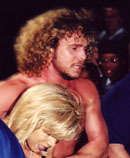
Brian Pillman [photo by Wade Keller (c) PWTorch]
And he also was around for the ineptitude of the first Turner/WCW head Jim Herd, who once decreed that wrestling fans had such poor attention spans that no WCW match should last over six minutes. Booker Dusty Rhodes dressed Pillman up in a full-bodied banana colored suit and called him "The Yellow Dog." WCW head Bill Watts thought Pillman was enough of an idiot that he would agree to renounce a lucrative contract in exchange for Watts's promise of a promotional push. Pillman, hardly a dumb jock, ignored him. Pillman was given the ridiculous gimmicks of "Baywatch" Brian and "California" Brian because the out-of-touch booker Ric Flair thought a cameo from Pillman on Baywatch would somehow cause fans to forget his life-long ties to Cincinnati.
Pillman, whose career coincided with the rise of the TORCH and Observer's coverage of the sport, also became somewhat of a newsletter legend. Besides the Watts dust-up and his use of newsletter raves about his match-work to get better contracts out of WCW (sharp-eyed viewers may have spotted a TORCH cover on Pillman's trophy wall during Vince McMahon's controversial interview with his widow, Melanie), Pillman became a hero to some behind the scenes when he back-downed a much-larger Sid Eudy in a fight in a hotel bar so effectively that Eudy ran back to his rental car to get a weapon. Sid became something of a legend himself when he returned to a bar full of wrestlers with, of all things, a squeegee to protect himself.
Pillman had to battle for everything he ever accomplished and he had to sacrifice his body in obvious and not-so-obvious ways. Because of his size he was compelled to have the best match on the show, with all of the damage to his body that entails, to stand out. Because of his size he was compelled to use steroids to build his upper-body, despite his family history of heart trouble, to keep up in the era of the big man.
Pillman's creation of the "Loose Cannon" persona, designed to once again jump-start a career and obtain another major company contract, proved him to be a true student of the business and may also have set the stage for his life's coda. The "Loose Cannon" persona proved Pillman to be as smart to the nature of the egotistical workers who run the business as he was talented in the ring. Pillman used Eric Bischoff and Kevin Sullivan's need to fool people, including their own employees, to get everyone in the business to talk about what he was going to do next.
He confused the veteran Bobby Heenan with his antics on live national television so much one night that Heenan swore and walked off the set. His fake/shoot match with Kevin "Booker Man" Sullivan probably perplexed most fans, but for a time made him the most talked about figure in the business, and in the small world of insider fans. He out-extremed Extreme Championship Wrestling, causing a sensation among the fans with his first appearance in the ECW Arena, and proposing a videotape that would couple a match with "Franchise" Shane Douglas with softcore footage of Brian and his Penthouse Pet wife. He caused so much trouble backstage by never breaking his psycho persona, and by using the last forbidden ECW word to describe the Gangstas in an in-ring interview, that New Jack responded with an 18 minute in-ring tirade of his own that wrecked the night's show - and added to the legend of the "Loose Cannon."
Pillman worked his persona every chance he could. He designed his own t-shirt and sold them to fans at strip clubs. He called up newspapers in character to harangue them about their wrestling coverage.
He crazy-talked call-in radio shows. He lived his gimmick 24 hours a day - almost.
It cost him. Certainly Pillman, for all of his intelligence and talent, had always had aspects of the "Loose Cannon" in his own character. He was a player in his personal life, having five children by at least three different women. He had struggled with substance abuse problems, particularly with alcohol and pain pills during his career. He had once been arrested for drunk driving in a crack house neighborhood in Cleveland while he was searching for one of his children's mother, with whom he was involved in a bitter custody dispute.
For a while, though, Pillman was able to stay sober. It didn't last. His need to stay in character led him back into the night.
But he changed his act so completely from stud-boy athlete to anarchistic psychopath that he caused a bidding war between the Big Two for his services, a war won by Vince McMahon and Titan Sports. It was a tribute to how slickly he pulled this off, and to how genuinely that Eric Bischoff liked him, that he was able to remain friends with Bischoff despite using his television shows to drive his price up and jump to the arch rivals. Pillman chose Titan for two reasons, one obviously being the guaranteed money.
The other was the chance he saw to finally main event for a national promotion. Pillman felt his psycho character was a perfect foil both athletically and psychologically for a babyface Shawn Michaels. Ironically, Michaels's life and career parallels Pillman's in many ways.
But it was not to be. Just after Pillman signed a guaranteed big-money, multi-year contract he flipped his hum-vee on a rainy Kentucky road, almost killing him and destroying his right ankle.
Just as he was ready to step onto wrestling's main stage he had to endure an excruciating recovery. His ankle was fused into one position. The pain became a constant, as did the prescription pills to combat that pain.
And Vince McMahon had a problem. His company was in the fight of its life with WCW. Fans, and the media who covered wrestling (including me), wanted faster, harder-hitting, better wrestled matches. WCW, with its seemingly unlimited budget, had perhaps the deepest talent pool in the sport's history to draw from and could better survive the inevitable injury toll this style of wrestling produced. McMahon had to find a way to compete with that pool of talent despite a plague of injuries to his own wrestlers.
Vince also made the mistake that so many older promoters make, sticking with what first made him successful, sluggish big-men, after the business changed. That meant he had even less compelling characters than he should have with which to draw money and attract TV ratings. Vince is in a war where, for once, he has fewer weapons than the other side.
That war certainly has a positive side. The fans are getting more value for their money, with consistently better shows and riskier storylines than ever before. The fan interest has meant more money for both of the Big Two.
The stakes are higher because the rewards are greater. The pressure on both sides of the war, to produce bi-weekly, weekly, and soon twice-weekly ratings-grabbing live television, to produce profitable monthly three-hour PPV shows, and to survive the Machiavellian political maneuverings behind the scenes, is immense and never-ending.
The pressure has taken a devastating toll on bodies, on psyches, on relationships, on families, and on alcohol and drug habits. Whatever the final toxicology reports say, Brian Pillman was a victim of that pressure.
It was clear on McMahon's face the night of Brian Pillman's death that he knew it. McMahon had the expression of a man who has seen the thing he feared the most come to pass.
The ugly truth is the death of Brian Pillman was not totally unexpected. The macabre speculation of "who's next?" that follows professional wrestling as it does rock music centered around Brian Pillman in the weeks before his death.
After the accident McMahon had pushed Pillman to return to the ring as quickly as possible. He needed cannon-fodder in the war against WCW and more, McMahon simply couldn't afford not to get a return on his guaranteed money investment. This, after all, was his money, not some billionaire's.
And Brian Pillman, who had turned "No" into achievement his entire life, wanted his time on the main event stage. He would never be "Flyin' Brian" again, but he would use his acting and psychological skills to excel in the ring.
So Pillman, fused ankle and all, returned to action. It was too soon. The pain was unbearable. Jim Neidhart was brought in to buy Pillman more recovery time.
The questions began to mount, questions that may never be answered. Pillman's premature return had caused him more pain and more damage. Stories surfaced about his erratic behavior, thought to be due to his use of prescription pills to deal with the pain in his ankle. The WWF had recently relaxed its drug policy citing the expense and the "lack of need" for it, but management singled out Pillman for a drug test because of his behavior. Pillman failed the test, reportedly due to steroids used in an attempt to strengthen his ankle, and the WWF kept him in the ring and on the road. Other wrestlers were worried that something would happen to Pillman, leading to a crackdown that might interfere with their own habits.
During this time Pillman began a storyline where he was purporting to bust up another wrestler's marriage to one of Pillman's real-life former girlfriends while his own marriage was crumbling. He watched his friend Steve Austin receive a storyline injunction to stay 50 yards away from someone days after his wife had obtained an injunction against him for the same thing. He was slated to begin a storyline custody battle for a child after his own custody battle - which had ended with the mother's suicide - had taken a devastating psychological toll on him.
And the truth was, he did a great job acting in the role. His wrestling and behind the scenes behavior was another matter. Something was clearly wrong.
And so, finally, whether from cumulative damage from a life in which so much had to be overcome, or from something else, Brian Pillman's heart finally gave out. He left five children, a wife with much to be resolved, and another baby on the way, a baby Pillman didn't live long enough to hear about.
He may have also left Vince McMahon and Titan Sports in real trouble, to wait in fear for the mainstream media to ask the devastating questions. Why was Brian Pillman allowed back in the ring? Why did Titan Sports feel the need to single out Pillman for drug testing, but not to pull him from the road and send him to rehab? Why did Titan continually promote the interview with Melanie Pillman during Raw in a clear attempt to get better ratings from his death? Did Brian Pillman's heart give out in part due to his years of steroid use that Pillman thought necessary due to the way Vince McMahon promoted wrestling in the '80s?
The fear clearly showed on Raw this Monday during Vince McMahon and Jim Cornette's bitter preemptive strike against Phil Mushnick of the New York Post and TV Guide.
Brian Pillman also left his most famous partner with much to think about. "Stone Cold" Steve Austin may have an even more agonizing decision to face than Pillman had to make about returning to the ring. Does Steve Austin, the most valuable piece of talent in the WWF, at the height of his career, gamble with paralysis and get back into the ring?
Titan Sports already knows the answer. After all, they've already promoted the match.
Bruce Mitchell of Greensboro, N.C. has been a Pro Wrestling Torch columnist since September 1990. Mitchell co-hosts a wrestling talk show on WKEW 1400 AM in Greensboro, N.C. Tuesday from 6-8 p.m. He recommends "Pryor Convictions" by Richard Pryor for your reading pleasure.
THE TORCH REACHES MORE COMBAT ENTERTAINMENT FANS THAN ANY OTHER SOURCE
PWTorch editor Wade Keller has covered pro wrestling full time since 1987 starting with the Pro Wrestling Torch print newsletter. PWTorch.com launched in 1999 and the PWTorch Apps launched in 2008.
He has conducted "Torch Talk" insider interviews with Hulk Hogan, The Rock, Steve Austin, Kevin Nash, Scott Hall, Eric Bischoff, Jesse Ventura, Lou Thesz, Jerry Lawler, Mick Foley, Jim Ross, Paul Heyman, Bruno Sammartino, Goldberg, more.
He has interviewed big-name players in person incluiding Vince McMahon (at WWE Headquarters), Dana White (in Las Vegas), Eric Bischoff (at the first Nitro at Mall of America), Brock Lesnar (after his first UFC win).
He hosted the weekly Pro Wrestling Focus radio show on KFAN in the early 1990s and hosted the Ultimate Insiders DVD series distributed in retail stories internationally in the mid-2000s including interviews filmed in Los Angeles with Vince Russo & Ed Ferrara and Matt & Jeff Hardy. He currently hosts the most listened to pro wrestling audio show in the world, (the PWTorch Livecast, top ranked in iTunes)
REACHING 1 MILLION+ UNIQUE USERS PER MONTH
500 MILLION CLICKS & LISTENS PER YEAR
MILLIONS OF PWTORCH NEWSLETTERS SOLD
PWTorch offers a VIP membership for $10 a month (or less with an annual sub). It includes nearly 25 years worth of archives from our coverage of pro wrestling dating back to PWTorch Newsletters from the late-'80s filled with insider secrets from every era that are available to VIPers in digital PDF format and Keller's radio show from the early 1990s.
Also, new exclusive top-shelf content every day including a new VIP-exclusive weekly 16 page digital magazine-style (PC and iPad compatible) PDF newsletter packed with exclusive articles and news.
The following features come with a VIP membership which tens of thousands of fans worldwide have enjoyed for many years...
-New Digital PWTorch Newsletter every week
-3 New Digital PDF Back Issues from 5, 10, 20 years ago
-Over 60 new VIP Audio Shows each week
-Ad-free access to all PWTorch.com free articles
-VIP Forum access with daily interaction with PWTorch staff and well-informed fellow wrestling fans
-Tons of archived audio and text articles
-Decades of Torch Talk insider interviews in transcript and audio formats with big name stars. **SIGN UP FOR VIP ACCESS HERE**