
SPOTLIGHTED PODCAST ALERT (YOUR ARTICLE BEGINS A FEW INCHES DOWN)...
It was at SummerSlam 2002, just five months after his WWE debut, that “The Next Big Thing” Brock Lesnar defeated The Rock to become the undisputed WWE Champion. At the time, it felt like a symbolic passing of the torch. Twenty-four years later, Lesnar once again found himself in the SummerSlam main event, this time losing to Oba Femi in a match that was explicitly framed as another passing-of-the-torch moment.
Brock Lesnar is truly one of a kind—or perhaps more accurately, once in a lifetime. Wrestling fans often describe special talents as “once in a generation,” but Lesnar belongs in an even rarer category. Professional wrestling, at its core, is simulated combat. With Brock Lesnar, however, it’s easy to forget the “simulated” part because everything he does feels so believable.
Lesnar’s gifts as an athlete are impossible to ignore. His combination of size, speed, explosiveness, and power is unlike anything the industry has seen. Yet his ability as a performer is often overlooked precisely because it feels so real. Nothing about Brock Lesnar comes across as performative. Whether he’s selling an opponent’s offense, showing pain, projecting intensity, or reacting with anger, confidence, or surprise, every expression and movement feels authentic. That authenticity is what separates him from nearly everyone else in professional wrestling.
If you take Brock’s word for it, he is now officially retired. After two legendary WWE runs separated by a successful UFC career, it seems like the perfect time to revisit three matches that best showcase the unique qualities that made Brock Lesnar one of the greatest attractions the wrestling business has ever produced.
Then: Brock Lesnar vs. The Rock (Summerslam 2002)
Brock Lesnar’s path to the WWE Championship was anything but a slow climb. After debuting the night after WrestleMania X8, he bulldozed every opponent placed in front of him, won the King of the Ring tournament, and earned a WWE Championship match against The Rock in the main event of SummerSlam 2002.
A common way to describe a Brock Lesnar match is that it has a “big fight feel,” and that atmosphere was already evident in his first WWE pay-per-view main event. Inside the Nassau Coliseum, the anticipation was palpable. Some of that was due to The Rock’s immense star power, but much of it stemmed from Lesnar’s aura. Even in the earliest stages of his career, he carried himself like a once-in-a-generation attraction. That presence often earned him favorable crowd reactions despite his aggressive, heel persona. In this match, the audience frequently cheered for Lesnar at the expense of the babyface Rock.
Many of the trademarks that would define Lesnar’s career are already on display. He moves with purpose, never wasting motion or taking unnecessary steps. Every movement is explosive, aggressive, and impactful. Those qualities create a level of believability that is unmatched in professional wrestling, making it easy to forget that what you’re watching is simulated combat.
Another defining characteristic of Lesnar’s matches is their simplicity. While his offense had not yet been distilled into German suplexes and the F-5, the structure of the match is remarkably straightforward. There are no elaborate sequences, intricate counters, or unnecessary flourishes. If Brock Lesnar’s style could be described as writing, it would be short, declarative sentences ending with an exclamation point. Simple, direct, and devastatingly effective.
This match gives us Brock Lesnar in his rawest form. He would continue to evolve over the next two decades, but he never lost the raw intensity and authenticity that made him such a unique performer. Those qualities were present from the very beginning and remained the foundation of one of the most remarkable careers in wrestling history.
Now: Brock Lesnar vs. Cody Rhodes (Summerslam 2023)
A frequent criticism of Brock Lesnar’s career was the extent to which WWE protected him. While that complaint often resurfaced after many of his biggest matches, the protection also produced significant long-term benefits. Until his most recent match against Oba Femi, facing Lesnar meant something. Competing with him meant something. Defeating him meant even more. Few wrestlers over the last 25 years have possessed the ability to elevate an opponent simply by sharing the ring with them. Brock Lesnar was that rare performer.
After failing to finish his story at WrestleMania 39, Cody Rhodes needed a meaningful detour before eventually returning to Roman Reigns. That side journey had to preserve his momentum while continuing to build his credibility as WWE’s next top star. Brock Lesnar was the perfect opponent. He was a seemingly insurmountable obstacle who could occupy Rhodes while giving him opportunities to display his toughness, resilience, and determination. After Cody stole a victory with a surprise roll-up at Backlash, Lesnar “broke” Cody’s arm in the lead-up to their rematch at Night of Champions. There, Brock trapped Rhodes in the Kimura Lock until Cody passed out from the pain, evening the series at one victory apiece.
Their decisive third match took place at SummerSlam in Detroit and serves as an outstanding example of how Lesnar’s believability and physical dominance can generate sympathy for a courageous babyface. The story is built around a simple but timeless formula: heat, sympathy, and a comeback.
For much of the match, Lesnar systematically dismantles Rhodes. His offense is, as always, believable and brutal, but it is his demeanor that truly tells the story. Brock smiles, laughs, and mocks Rhodes as he repeatedly throws him out of the ring, confidently telling him to stay down. At first, the crowd is slow to recognize where the story is headed, but after an F-5 on the floor and another onto the announce table tease a count-out victory, the audience fully invests in Cody’s struggle. They desperately want him to beat the count and continue fighting. On paper, it is a simple story. In execution, it becomes compelling because of Lesnar’s arrogance and Rhodes’ relentless determination.
The comeback begins when Cody slips out of an F-5 and sends Lesnar head first into the ring post and starts his rally of offense. This provides another example of Lesnar’s underrated selling. Rather than simply collapsing on every blow, he staggers backward before finally falling, making the impact feel heavier and more realistic. The match also revisits the Kimura Lock, the submission that had “broken” Cody’s arm earlier in the rivalry. By this stage of Lesnar’s career, the Kimura had become one of his defining weapons, so the crowd immediately understood the danger when he applied it. The drama reaches its peak when Rhodes escapes, sends Lesnar into the exposed turnbuckle, and applies the Kimura himself. Moments later, Cody delivers three Cross Rhodes and finally scores the pinfall.
It is not a complicated match, nor does it need to be. It succeeds because every element serves the central story. As the comeback builds, the crowd grows more invested with each passing minute before erupting for the decisive pinfall. More than anything, the match demonstrates Brock Lesnar’s greatest value. His aura, physical dominance, and carefully protected credibility made him one of wrestling’s ultimate measuring sticks. For more than two decades, there was no greater endorsement of a rising star than surviving Brock Lesnar—and no greater statement than defeating him.
Forever: Brock Lesnar vs. CM Punk (Summerslam 2013)
Brock Lesnar essentially had two distinct WWE careers, and each featured a different in-ring style. During his initial run, Lesnar wrestled a physically dominant, impactful style, but it was also more traditional. His matches were longer, his offense was more varied, and the storytelling followed a more conventional structure. After returning to WWE following his successful UFC career, Lesnar simplified his approach. His matches became shorter, his offense more streamlined, and his storytelling relied less on complexity and more on simplicity, unpredictability, and the constant sense of danger he brought to every encounter.
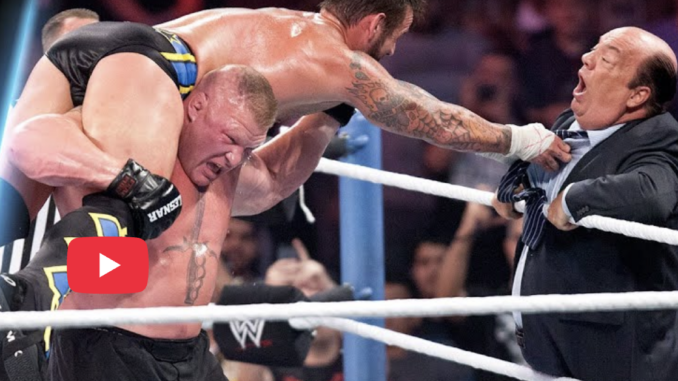
His SummerSlam match against CM Punk is one of the best examples of both versions of Brock Lesnar coming together. This was before “Suplex City,” so his offense was still remarkably diverse. In fact, Lesnar doesn’t hit a single German suplex during the match. At the same time, we see the dangerous Brock—the version who always seemed on the verge of losing control. That unpredictability creates excitement because every action feels as though it carries real consequences. One of the best examples comes when Lesnar throws Punk onto the announce table, covers him with the tabletop, and then, without warning, launches himself onto the pile. It feels less like a wrestling spot and more like an act of violence. Once again, Lesnar blurs the line between simulated combat and reality through the sheer believability of his performance.
Another aspect of Lesnar’s work that is often overlooked is the way he embraces contact. He understands that, because of his size and credibility, he cannot convincingly be staggered by weak-looking strikes. Rather than leaning away from incoming offense, he leans into it. During Punk’s flurry of roundhouse kicks, Lesnar absorbs each strike, allowing the kicks to land cleanly before selling them in a believable manner. The result looks like a smaller fighter using speed and precision to neutralize a much larger opponent. It is performance art that never feels like a performance.
Lesnar’s pacing is equally impressive. He understands when to slow down and allow a moment to breathe. One of the best transitions in the match comes when his Kimura Lock is countered into a triangle choke. Lesnar powers out with a thunderous powerbomb, then pauses as the crowd erupts, patiently waiting for Punk to get back to his feet. By resisting the urge to rush into the next sequence, he allows the audience to absorb what just happened, making the exchange feel far more significant. The same patience is evident when he retrieves a steel chair from ringside and again before delivering the match-ending F-5. In both moments, Lesnar lets the anticipation build before finally delivering the payoff.
As great as Lesnar is, Paul Heyman is just as essential to this match. Whether on the microphone or at ringside, Heyman was an indispensable part of Lesnar’s presentation. He never takes a moment off. Every facial expression, every reaction, and every movement enhances the drama. At times, the cameraman almost has to resist focusing on Heyman because he is constantly adding to the story.
Heyman’s involvement reaches its peak during the closing stretch. When CM Punk grabs a steel chair to attack Lesnar, Heyman pulls it away from the apron, allowing Brock to recover. Moments later, as Lesnar attempts the F-5, Punk grabs Heyman’s tie to block the move. Heyman’s frantic facial expressions and desperate mannerisms are priceless. Later, after Punk hits the Go to Sleep and appears to have the match won, Heyman breaks up the pinfall. As Punk turns and locks eyes with him, Heyman’s terrified expression perfectly communicates the desperation of the moment.
This match is another example of Brock Lesnar stealing the show at SummerSlam. He did it in his first SummerSlam main event against The Rock. He did it again here against CM Punk. He repeated the feat the following year when he demolished John Cena, and many would argue he did it one final time in his farewell match against Oba Femi. Few performers have consistently defined WWE’s biggest event of the summer quite like Brock Lesnar.
Leave a Reply
You must be logged in to post a comment.