
SPOTLIGHTED PODCAST ALERT (YOUR ARTICLE BEGINS A FEW INCHES DOWN)...
Recently, WWE has presented an unusually high number of major title matches on television. In fact, in September alone we will have at least three major titles defended on television. One of which resulted in a surprise title change. In the last decade, with many champions working part-time schedules, major title matches on television have become a rarity. Scarcity creates value and importance, and because televised title matches have become so rare, I do believe that a main event with a title on the line has become much more important than it once was. With that said, a big title match on RAW or SmackDown creates destination viewing for the episode, and WWE could benefit from more frequently promoting a main event that fans will go out of their way to watch live.
My most intense and obsessive viewing as a wrestling fan occurred during the Attitude Era. During this era, title matches on television were much more frequent. Obviously, this was a byproduct of the competition with WCW during the Monday Night Wars. There were advantages and disadvantages to this frequency. On the positive side, RAW felt can’t-miss during this era. You never knew when a major match or major title change was going to occur, so the viewer felt like they had to tune in to watch. Conversely, so many title matches did water down their novelty factor. As a child whose parents did not allow him to order pay-per-view events, I did not feel like I was missing out on the only important marquee matches from the WWF product.
As with almost everything in wrestling, there appears to be a magic middle ground to shoot for, where title matches are seen as important and novel but are still frequent enough to generate a periodic buzz of excitement when needed. In this article, I will cover three memorable or notable title matches that occurred on weekly WWE television.
Then: Steve Austin vs. Kurt Angle (WWF Raw: Oct. 8, 2001)
Pop quiz: when and against whom did Steve Austin last win the WWF Championship? My guess is that very few people would remember that Steve Austin’s last title victory came against Kurt Angle on the October 2001 episode of Monday Night Raw.
This title victory occurred during Austin’s often-criticized, and rightfully so, heel run. While I agree that Austin’s heel turn as a whole was not successful, I would contend that his wrestling style as a heel was a more exciting version of the brawling style Austin mastered during his post-neck-injury main-event run. During this heel run, Austin created a unique in-ring style that blended the frantic, relentless, attack-the-mat, bumping heel style apparent during his Stunning Steve Austin run with the back-and-forth brawling style that typified the main events of the Attitude Era. Moreover, this match displays Austin against the competitor with whom he had the best in-ring chemistry during his heel run: a babyface Kurt Angle.
The match begins with back-and-forth brawling that is intense and nonstop, with Angle, as the babyface, matching Austin’s aggressiveness. The energy and tone established by the two wrestlers are mirrored and matched by the live crowd. The second half of the match is an example of the bumping heel style that Austin displayed during his WCW days. The pacing is unrelenting. There is more off-the-ropes action in this match than you see in perhaps any promotion or match today. It is almost as though Austin is attempting to blow up the Olympic Hero.
It is often complained about in the modern day that there are too many referee bumps and screwy finishes, but this is far from new. This match is a great example of a style we see today that was already being used during the Attitude Era. Referee Earl Hebner is bumped during the final stanza of the match. WWE Commissioner William Regal enters the ring and attempts to prevent Austin from using the belt to regain the championship, but Regal fakes like he is going to hit Austin before hitting Angle. Classic misdirection.
My favorite part of the match is the final 30 seconds. Austin goes for the pin, and Angle miraculously kicks out. The crowd goes wild, and Austin goes ballistic. Austin allows Angle to get to his feet before hitting the final Stunner, the nail in the coffin, to regain the championship he had lost to Angle two weeks earlier.
The match is a great example of a title match done right on television. By this time, Austin and Angle had already fought at SummerSlam and Unforgiven, but the feud was so successful that there was still meat on the bone. This is an example of using television to finish a feud in a climactic manner. It is also a great display of the difference Austin brought to the table as a heel and perhaps the best babyface run of Kurt Angle’s career.
ARTICLE CONTINUED BELOW…
Check out the latest episode of “Worse or Better” with Stephanie Chase and Josh White, part of the PWTorch Dailycast line-up: CLICK HERE to stream (or search “pwtorch” on Spotify, Apple Podcasts, or any other iOS or Android app to subscribe free)
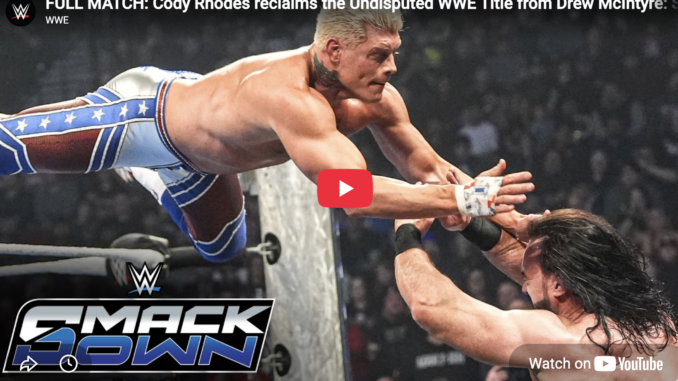
Now: Cody Rhodes vs. Drew McIntyre (WWE Smackdown: Mar. 6, 2026)
In 2026 alone, WWE has had four major title changes on weekly television, and the year still has over three months remaining. The first came unexpectedly on January 9 when Drew McIntyre defeated Cody Rhodes for the WWE Championship on SmackDown. This added a significant amount of intrigue to the road to WrestleMania, as multiple options and scenarios were formulated and hypothesized as potential WrestleMania main events. Who would have the title by WrestleMania? Who would challenge for the title at WrestleMania? How many challengers would be in the WWE Championship match at WrestleMania? These were all reasonable questions created by this unexpected title change.
All of the questions were answered when the dust settled during the first week of March. Randy Orton won the Elimination Chamber, securing his spot as the challenger for the WWE Championship on the last day of February. Less than a week later, Cody Rhodes defeated Drew McIntyre to reclaim the title and secure the WrestleMania main event slot. The two WWE title changes that occurred on television significantly enhanced the intrigue and speculation during the first two months of the year.
The second title match did not have the level of surprise that the first had, but as WrestleMania drew closer, the urgency of the moment intensified into a palpable feeling when the competitors entered the ring. Drew’s heel work during the match is commendable. To start the match, Drew uses a time-tested heel tactic that will always generate a negative reaction: he bails from the ring and tries to avoid the fight. Cody, being the aggressive babyface, attacks him and forces him to go through with the match.
Another great heel tactic that Drew implements is utilizing the ring and ringside environment to inflict damage or turn the tide against the babyface. I am quite confident that Drew learned this skill from Fit Finlay, and it is a technique that many heels should use more often. It is the perfect heel tactic: bend the rules enough that the fans realize it is a shortcut, but not far enough that it creates a scenario where a disqualification is warranted.
In this particular match, Drew uses the steps and ring apron to deliver a sidewalk slam off the steps onto the apron, turning the tide of the match. The most important heat spot occurs a few minutes later, when Drew powders out of the ring and uses Cody’s aggressiveness to pull his arm into the post. From there, Drew creatively and systematically works Cody’s arm, creating the major theme for the match’s story.
Cody turns the tide late in the match with a trademark, fired-up babyface comeback. From there, they pull from the modern-day WWE main-event style playbook: trading finishing moves and hitting their opponents with each other’s finishers. In the match, Drew delivers a Cross Rhodes to Cody, which honestly looks better than when Cody delivers the move. In turn, Cody delivers a Claymore Kick, which honestly does not look as devastating as Drew’s.
The finish is also typical of a WWE main event, which would not be as negative if it did not occur so frequently. The referee is bumped, and Drew, the heel, attempts to cheat by hitting Cody with the belt. However, on this occasion, Jacob Fatu, who was responsible for Drew’s title victory in January, intervenes and stops Drew from fulfilling his underhanded attempt. Cody seizes the opportunity to hit Drew with the Cross Rhodes, win the match, and win back the title.
The WWE Championship program leading to WrestleMania will not be looked upon fondly in the history books or in the memories of fans. The involvement of Pat McAfee has certainly created a dark storm cloud over the lead-up to the biggest show of the year. I would argue that prior to the McAfee dumpster fire, the WWE Championship program and the two title changes on television elevated interest and intrigue on the road to WrestleMania.
The weekly questions that were posed, the speculation that they created, and the meaningful moments that occurred built significant drama and interest. The follow-up is what torched all of the positive momentum and potential satisfaction.
Forever: Triple H vs. Chris Jericho (WWF Raw: Apr. 20, 2000)
When you have watched over 1,500 episodes of the same television show, it is easy for most shows to just blend together. So, what makes a particular show or a particular moment stand out? An unannounced, impromptu WWF Championship match featuring the top heel in the company against an up-and-coming babyface who would have never sniffed the title, used to kick off a show, is one way. That is exactly what we got on the April 20 edition of Monday Night Raw in the year 2000.
To kick off the show, Chris Jericho baited Triple H into putting his title on the line by insulting his wife, and the match was on. The match itself is pure electricity. It comes out of the blocks with unrelenting aggressiveness, with Jericho overwhelming the dominant champion and exciting the fans in the process. The match is less than 10 minutes, but the energy and urgency never wane, and the crowd’s excitement and engagement never relent.
As is typical with WWE’s main-event style, a major turning point in the match is the referee bump. In this case, the referee bump allows Shane McMahon to cut off Jericho’s momentum by crotching him on the top rope. Before he can add to the advantage, however, he is chased off by the Acolytes Protection Agency. Stephanie slides the belt into the ring to give Triple H the ability to put the match away, but Jericho steals the belt from Triple H and lays him out.
We get a visual pinfall without a referee, with the entire crowd on their feet, waving for a new referee to come to the ring. That new referee is Earl Hebner, who had been involved in the storyline with Triple H and had been bullied by the McMahon-Helmsley regime. Triple H kicks out from the belt shot, much to the dismay of the crowd. He then argues with Earl, which gives Jericho the ability to turn the tide back in his favor and deliver the Lionsault for a fast three-count. The crowd erupts, and Triple H’s facial reaction to the surprise loss is priceless.
These 10 minutes of television have lived on in my memory for over 25 years. The unexpected nature of the title match, the title change, and the energy in the arena are what set it apart in my long-running interest in WWE. Now, a lot of people will complain about the aftermath of the title victory, where Triple H bullied Earl into reversing the decision and striking the title change from the record. However, the unique manner in which the aftermath played out on that single television show has made the moment—and the phantom title change—more notable and memorable than it would have been if it had simply ended with the title changing hands.
Leave a Reply
You must be logged in to post a comment.