SPOTLIGHTED PODCAST ALERT (YOUR ARTICLE BEGINS A FEW INCHES DOWN)...
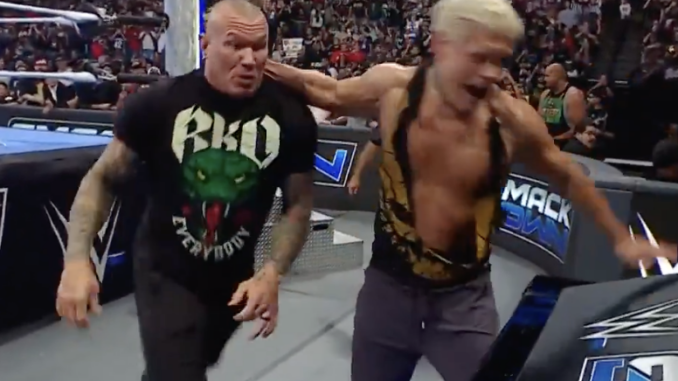
One of the current main-event storylines on WWE programming is “The American Nightmare” Cody Rhodes versus “The Viper” Randy Orton. Whether you consider this a continuation of their WrestleMania headlining feud – or perhaps a make-good for the shortcomings and unnecessary detours that derailed that program – Cody and Randy are once again standing face-to-face, man-to-man, on WWE SmackDown.
Randy Orton and Cody Rhodes have a relationship that stretches back well over a decade. Cody’s first match on WWE main roster programming was against Orton, and he later became one of Randy’s henchmen alongside Ted DiBiase in the heel group Legacy. After Legacy broke apart, Cody and Randy had a brief feud that is often forgotten. Even before Cody’s departure from WWE, the two found themselves on opposite sides of another storyline, with Orton representing The Authority and Cody standing alongside his brother Goldust and their father, “The American Dream” Dusty Rhodes. That program also marked Dusty’s final major character appearance on professional wrestling television.
Since Cody’s return to WWE, he and Randy had largely been portrayed as friends. That friendship came to a dramatic end when Randy viciously attacked Cody, transforming their WrestleMania main-event title match into a personal grudge match. Unfortunately, in the weeks that followed, the feud seemed to lose its way. Or, perhaps more accurately, a hot feud became a dumpster fire. The introduction of Pat McAfee into the program, along with an abundance of meta nonsense, left many wrestling fans frustrated. A lackluster match at WrestleMania did little to remove the sour taste the program had left behind.
Now, four months later and following a 100-day absence, Randy has returned to attack Cody, and in many ways, we are right back where we started in January. Hopefully, this time WWE keeps the destination in mind and takes a more straightforward route to get there. Cody and Randy have too much significant history—or should I say Legacy—for this story not to receive a climactic conclusion worthy of their long relationship.
In this week’s column, we will explore three matches from the lengthy and interconnected history between Cody Rhodes and Randy Orton.
Then: Cody Rhodes vs. Randy Orton (Smackdown: Nov. 4, 2011)
The breakup of Legacy in 2010 and the subsequent feud between its members and Randy Orton ultimately did little for Cody Rhodes – and, frankly, I’m not sure it was supposed to. It’s easy to forget now, but after Legacy broke apart, many fans, and probably WWE Creative, believed Ted DiBiase Jr. was more poised and ready to be elevated up the card than Cody Rhodes. Cody was the tagalong. In the end, however, the feud did little for Cody and even less for DiBiase, as neither man was established as a truly believable threat to Randy Orton.
Cody’s first real momentum as a singles star came the following year in his feud with Rey Mysterio. That program involved Mysterio damaging Cody’s face and Cody subsequently wearing a mask. On paper, it sounds bizarre. In practice, Cody used the mask remarkably well—not only as a defining part of his persona, but as a heel tactic that helped him score victories and eventually capture the Intercontinental Championship.
In late 2011, Orton and Rhodes were once again pitted against each other, although this time their roles were reversed. Orton was the babyface, while Rhodes was the delusional heel. They opened the November 4 edition of SmackDown with a Street Fight. When modern WWE fans hear “Street Fight,” they generally think of weapons. That isn’t the case here, and the match is arguably better because of it. Today, when a wrestler immediately starts searching under the ring for a weapon, it can sometimes take away from the aggression of the fight. The act becomes less about two people trying to hurt each other and more about waiting for the next piece of “plunder” to be introduced.
That isn’t the approach Orton and Rhodes take. They establish the tone immediately with an aggressive brawl that spills around ringside. I admire a good working punch, and both Orton and Cody throw convincing ones, making the fight feel visually believable. The match feels like a fight first and a Street Fight second. Another great element is Cody’s use of his baggers. When they attempt to interfere and give Cody an advantage, Orton foils their efforts, drawing some great reactions from the crowd. But the central story of the match is Cody’s mask.
Cody uses the mask as a weapon to turn the tide and gain the advantage over Orton. It is a time-tested heel tactic: the villain uses an underhanded advantage to stop a rallying babyface who has begun to overwhelm him. What makes the spot particularly effective is the match’s restraint. Because there is an absence of weapons throughout the match, the mask actually means something when Cody uses it. If a plethora of weapons had already been introduced before and after the mask shot, the moment would lose much of its impact. Instead, the mask is the weapon. Its use feels significant because everything else has been kept relatively grounded.
The story comes full circle in the latter stages of the match when Orton turns Cody’s own weapon against him, using the mask to begin his comeback. From there, we get another underrated aspect of Randy Orton’s performance: his ability to rally a crowd. Orton makes his traditional comeback, and when he begins setting up the RKO, the crowd is fully invested and on its feet. Cody counters the RKO and hits the Disaster Kick, producing his most meaningful near fall of the match. After a few more reversals and a Draping DDT on the floor, Randy throws Cody back into the ring and hits an emphatic RKO to win the match.
This is a great example of a Street Fight done right. It isn’t about the weapons. It isn’t even necessarily about the spots. It’s about the aggression, the tone and, most importantly, the story.It is also a great example of the importance of Randy Orton to Cody Rhodes at this stage of his career. Cody was a midcarder through and through at this point, but by giving him a competitive match with Randy—one in which Orton sold for him, gave him meaningful near falls and brought the crowd into the match—Orton helped Cody feel like a bigger star and a legitimate threat to a main-event competitor.Cody didn’t need to beat Randy Orton to benefit from working with him. He needed Randy Orton to make the audience believe that Cody Rhodes belonged in the ring with Randy Orton.
ARTICLE CONTINUED BELOW…
Check out the latest episode of the Wade Keller Podcast weekly Tuesday Flagship: CLICK HERE to stream (or search “wade keller” on Spotify, Apple Podcasts, or any other iOS or Android app to subscribe free)
Now: Cody Rhodes vs. Randy Orton (WWE Night of Champions: June 28, 2025)
When Cody Rhodes returned to WWE in 2022, many fans immediately anticipated a future Cody Rhodes–Randy Orton feud. We ultimately had to wait three years to get it. More than a decade after their previous singles encounter, Rhodes and Orton finally squared off in the finals of the 2025 King of the Ring tournament at Night of Champions in June 2025. This time, both men were babyfaces, fighting not only for the King of the Ring crown but also for an opportunity to challenge for the championship at SummerSlam. Given those stakes, the premise was simple: two friends and established heroes were forced to compete against one another for an opportunity to reach the top of WWE.
For me, this match is a great display of the equity Randy Orton has built with the WWE audience. I remember Sean Waltman discussing the difference between wrestling to get over and wrestling once you are over. Randy Orton is firmly in the latter category. His music, mannerisms, move set and finishing move have all become so deeply connected with the audience that, as long as Randy Orton performs as Randy Orton, the equity he has built does much of the heavy lifting. You can see that before the bell even rings. The Saudi Arabian crowd is immediately enthusiastic for both Cody and Randy, and there is a genuine anticipation to seeing these two friends lock up and compete against one another.
The most important move of the match comes relatively early when Randy Orton delivers a Superplex to Cody from the top rope. Orton immediately sells his back, establishing the foundation for a story that becomes a central theme of the entire contest. To his credit, Orton’s selling is both realistic and consistent. Even when he fires up for his comeback, he never loses sight of the injured back. It is clearly causing him considerable pain and limiting what he can do. Cody, despite being the babyface, targets Randy’s back. It borders on a heel tactic without ever crossing that line. Cody isn’t suddenly cheating or behaving like a villain; instead, his actions demonstrate how badly he wants to win. He is willing to attack the compromised body part of his friend because the opportunity to challenge for the championship means that much to him.
The other major story point comes toward the end of the match when Randy sets up for the Punt. Orton hesitates, seemingly battling with his conscience. Eventually, he decides to go through with it, but that hesitation gives Cody the opportunity to avoid the move and cut Randy off.
In the final chapter of the match, Randy attempts to create an advantage of his own. He distracts the referee and removes the turnbuckle cover, and when Cody realizes what Randy is attempting to do, he fights him off. Randy goes for the RKO, but Cody counters by pushing Orton sternum-first into the exposed turnbuckle. Cody follows with Cross Rhodes to win the match. It is a great example of a babyface whose judgment becomes clouded by the desire to win. Cody doesn’t cheat in the traditional sense, but Randy’s willingness to bend the rules creates an opportunity that Cody ultimately exploits. The finish reinforces the central idea of the match: these are two good guys who desperately want to win, and that desire creates shades of gray without either man having to turn heel.
This contest is a great example of what a Randy Orton–Cody Rhodes WrestleMania main event could have been before Orton’s heel turn and Pat McAfee’s involvement sent their program down the road it ultimately traveled. There was a lot of criticism of the decision to make the WrestleMania match a face-versus-face contest. I understood the criticism, but I never thought the premise itself was the problem. In fact, I thought it had the potential to work precisely because of the history between these two men. This match provides the evidence. Cody Rhodes and Randy Orton didn’t need one of them to be a villain for the audience to care. They were two established heroes fighting for an opportunity at the championship, and that alone provided enough motivation to create conflict, emotion and a meaningful story.
In many ways, this is what their WrestleMania main event could have been. Two friends with a complicated history, competing for the biggest prize in the industry, with both men desperate enough to test the limits of their friendship. The ingredients were already there. Cody Rhodes and Randy Orton didn’t need a heel turn, a celebrity attraction or a complicated meta storyline. They simply needed a reason to fight—and enough time to let the history between them do the work.
Forever: Cody Rhodes vs. Randy Orton (Raw: Sept. 2, 2013)
What made the WrestleMania match and the feud so disappointing? Going into the contest, I certainly didn’t believe the problem would be a lack of chemistry. Their history had already demonstrated that Randy Orton and Cody Rhodes possessed both strong in-ring chemistry and compelling character chemistry. My evidence for that claim is highlighted by their Raw match from September 2, 2013.
At the time, Randy Orton was the handpicked WWE Champion, supported by Triple H and The Authority as the company’s chosen representative. The moniker was deliberately used to distinguish Orton from the fan-favorite Daniel Bryan, who had been positioned as the champion’s opposite. Cody Rhodes, meanwhile, was still struggling to find his place and fight his way out of a crowded midcard.
The setup for the match was simple, but effective. Cody, speaking on behalf of the fan favorites in the locker room and the crowd, confronted Triple H and Randy Orton backstage and argued that what was best for business was giving Daniel Bryan another opportunity at the WWE Championship. To punish Cody for his outspoken comments, Triple H booked an impromptu match against Orton, with the implication that Cody’s WWE career was on the line.
That simple premise immediately raised the stakes and gave both wrestlers a reason to have a heated contest. Cody came out with fire from the opening bell, matching Orton’s aggression and demonstrating the toughness that would eventually become such an important part of his character.
For his part, we get “normal” Randy Orton—and for some, that might highlight Orton’s limitations. For me, however, I’ve developed a greater appreciation for what Orton does precisely because of what he doesn’t do. Randy Orton is a great example of a wrestler in which everything is purposeful and character-consistent. Every move, every glance and seemingly every movement has a reason behind it. It isn’t simply what he does; it’s how he does it.
The little things are where Orton has mastered his craft. How he shoots an opponent into the ropes. How he goes for a pin. How he kicks out of a pin. His range of selling, not only physically but facially. Even the way he applies a hold has an attention to detail. Calling it a “rest hold” almost undermines the way Orton applies it because even in those moments, he is communicating something about his character.
The other performance worth highlighting is Cody Rhodes. It would be easy to say that, at this point in his career, Cody had all the tools. His failure to be elevated may have been because he wasn’t given the right opportunities to use those tools—or perhaps because he didn’t always use the right tool at the right time against the right opponent. But in this match, the Babyface fire and intensity that have become trademarks of “The American Nightmare” are already on full display.
That fire helps Cody transform what begins as a relatively lukewarm crowd response into a full-throated “Cody!” chant by the end of the match. As Cody mounts his comeback, the audience becomes completely invested. They are no longer simply watching Cody Rhodes wrestle Randy Orton; they are invested in Cody beating Randy and saving his career.
The climax comes when Cody counters an RKO and hits Cross Rhodes for a very close near fall. At that moment, the transformation is complete. What began as a lukewarm response has become a crowd that is fully behind Cody Rhodes.
Unfortunately for Cody, he misses the Disaster Kick, tweaks his knee and walks directly into an RKO, giving Orton the victory. The final scene, however, demonstrates just how effectively both men had done their jobs. Triple H appears on the stage and offers Cody a sarcastic congratulations before firing him.
The sympathy for Cody is palpable throughout the arena as he makes his slow exit from the ring. In the span of one match, Cody Rhodes had gotten the audience to care about him, care about his career and, most importantly, care about the story. Some of that was Randy Orton. Some of it was Cody Rhodes. But together, it was a full display of the chemistry these two had developed and a glimpse of what Cody would eventually learn to harness during his main-event run.
That is why this match is such a worthwhile watch. It captures Cody Rhodes at an incipient stage of the performer he would eventually become—and it provides compelling evidence that when Cody Rhodes and Randy Orton were given a simple story, meaningful stakes and the freedom to work, chemistry was never the problem.