SPOTLIGHTED PODCAST ALERT (YOUR ARTICLE BEGINS A FEW INCHES DOWN)...
In September 2019, NXT debuted on cable television as a two-hour live broadcast every Wednesday night. The change in day, format, and platform was designed in large part to curtail the momentum of the upstart AEW and ensure that WWE maintained its dominant position in wrestling television in the United States.
Initially, many fans were excited about the prospect of the “Wednesday Night Wars,” with AEW and NXT competing directly for weekly television viewers. In time, however, NXT bowed out of the fight by moving the show to a different night of the week. Without directly saying so, the move was widely viewed as an acknowledgment that NXT had lost the ratings battle to AEW.
While I was initially intrigued by the direct competition between rival promotions, the short-lived “Wednesday Night Wars,” combined with the COVID-19 pandemic, helped bring an end to one of my favorite eras in professional wrestling: NXT “Black and Gold.”
At a time when WWE’s main-roster programming was often more of a source of frustration than excitement, NXT provided a more action-packed in-ring product. It featured new characters, cohesive storylines built around the importance of winning and losing, and a short-and-sweet one-hour television format. It provided enough action to satisfy your appetite without leaving you overfilled and exhausted.
NXT 2.0 represented a rebuilding era that, while initially a regression in terms of wrestling quality, was ultimately a return to the brand’s original purpose: developing wrestlers for prime-time spots on the WWE main roster. The first year of NXT 2.0 was more disappointing than satisfying, but the product gradually improved and eventually led to the emergence of a new crop of younger talent who were better suited for the main roster.
While the current head of NXT creative, Shawn Michaels, is not universally loved by Internet wrestling fans, I believe he has done a commendable job taking wrestlers with potential but limited experience and giving them opportunities to take chances, develop their skills, and, importantly, fail while learning from those failures.
Under Michaels’ leadership, Bron Breakker, Trick Williams, Carmelo Hayes, Oba Femi, and Fatal Attraction have all improved in front of the audience and, in various ways, been prepared for the main roster with many of the skills needed to succeed.
It doesn’t seem like it has been around this long, but after more than a decade of NXT, countless memorable matches and moments have taken place. In this article, I will highlight three that stand out to me the most.
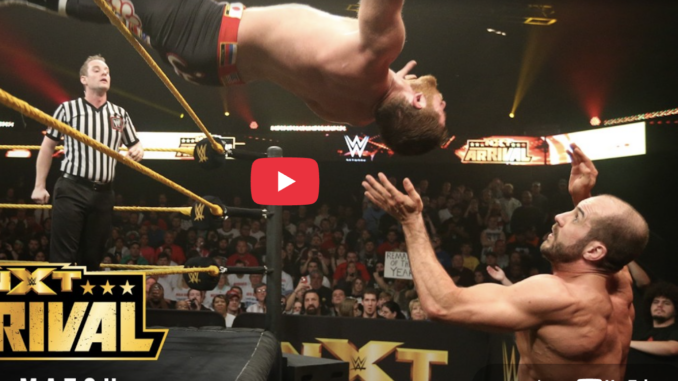
Then: Sami Zayn vs. Cesaro (NXT Arrival: Feb. 27, 2014)
NXT Arrival was a historic event for multiple reasons. It was the first WWE live event ever streamed on the brand-new WWE Network, but more importantly, it essentially marked the arrival of NXT as a distinct third brand under the WWE umbrella.
The current version of NXT, which began as WWE’s new official developmental league, was established in Florida in the summer of 2012. Prior to Arrival, the brand was still in its startup phase. Triple H and his team were developing a vision and mission for the new NXT, recruiting coaches and talent, and building the infrastructure necessary to turn the concept into something sustainable.
By the time Arrival took place, the template for NXT had been established under Triple H’s direction, and momentum was beginning to build at the grassroots level. Arrival felt like the official launch of what NXT was intended to become.
The expression “you only get one chance to make a first impression” seems particularly fitting when describing NXT Arrival. The talent chosen to make that first impression were Sami Zayn and Cesaro, and undoubtedly, they were the right choices.
Both men were beloved independent wrestling favorites with impressive resumes, including extensive work in Ring of Honor. More importantly, they had already been involved in a rivalry centered almost entirely on in-ring competition and proving who was the better wrestler. That rivalry would continue to produce memorable matches, including their excellent two-out-of-three falls match a few months later.
Many people would categorize this match as “indy style,” but I would push back on that characterization. While independent wrestling can sometimes emphasize moves over everything else, this match was fundamentally about the story. Yes, many of the moves were impressive, but what made the match special was Zayn fighting from underneath. He repeatedly hit desperation moves to create believable near falls, while demonstrating a relentless commitment to getting back to his feet and continuing the fight.
For that story to work, however, you need a credible bully on the other side of the equation, and Cesaro was the perfect man for the role. His bully tactics and roughhouse beatdown of Zayn were aggressive and methodical without turning him into an over-the-top heel. The match never felt like it was breaking the established rules of a professional wrestling contest. Cesaro was simply bigger, stronger, and more physically imposing, while Zayn was desperately trying to find a way to survive.
I also love the finish. After hitting an impressive Helluva Kick, Zayn nearly puts Cesaro away, but Cesaro barely kicks out. Cesaro then counters Zayn with a Pop-Up European Uppercut. When Cesaro goes for the pin, however, Zayn kicks out at one and wills himself back to his feet, much to the delight of the crowd. Instead of adding several more sequences or false finishes, Cesaro simply hits Zayn with another beautiful uppercut, follows it with the Neutralizer, and gets the clean pinfall.
This was a great example of a match where Cesaro went over, but Sami Zayn got over. The post-match respect between the two men reinforced the idea that this wasn’t simply a showcase match for NXT; it was a statement about what NXT could be. Sami Zayn had arrived, and so had NXT.
Now: Lola Vice vs. Kendal Grey (NXT Great American Bash: June 28, 2026)
Perhaps NXT’s biggest contribution to the professional wrestling industry at large has been the way it changed the perception of women’s wrestling. Prior to NXT, women in WWE were often presented more as eye candy for male fans than as competitors who could have serious, athletic matches and be taken seriously as wrestlers.
NXT helped change the way women were presented in WWE and, consequently, changed the way women’s wrestling was perceived throughout the industry.
From the original Four Horsewomen to incorporating women from Japan with extensive experience and incredible skill, such as Asuka and Iyo Sky, NXT consistently presented its women as serious competitors. In more recent years, one of the chief selling points used to distinguish NXT has been the claim that it has “the best women’s division in all of wrestling.” With only a few detours along the way, that message has remained consistent. The women of NXT have been presented with a level of seriousness that respects not only their beauty, but also their athleticism, skill, and ability to tell compelling stories in the ring.
Two standout NXT women in 2026 have been Kendall Grey and Lola Vice. Grey is a spitfire. Unlike some of the other recent NXT women, she does not emphasize a traditionally glamorous presentation or flashy moves. While she is certainly a great athlete, her athleticism is displayed through her speed, technical ability, and grappling. She is small, but she packs a punch that prevents her stature from taking away from her credibility as a competitor.
As for Lola Vice, she is an interesting blend of different qualities. She has the sex appeal, legitimate combat-sports experience, and Latin flair that make her stand out. Her time in AAA has also done a lot to earn my respect. Wrestling women with a completely different style, in a completely different atmosphere, can be difficult for anyone, especially someone with limited experience. Lola has consistently risen to that challenge.
In the summer, Lola and Kendall main-evented The Great American Bash and displayed exactly what makes each of them such special talents with tremendous potential. The wrestling in this match was almost flawless. More importantly, they did not rely on overly complicated spots or pretty moves simply for the sake of being pretty. The match felt like an athletic contest between Kendall’s grappling ability and Lola’s striking. Combat and competition were placed ahead of overt acrobatics.
The pacing, urgency, and purposefulness of each move and sequence created an atmosphere in which winning felt like the most important thing. Late in the match, the counters to submission holds elevated the drama to another level. Rather than relying on multiple finisher kickouts to create drama, they went with a quick counter into Kendall’s Shades of Grey for an emphatic, albeit somewhat sudden, victory.
Both Lola and Kendall have had a great year, continuing the tradition of strong women’s wrestling in NXT while giving WWE fans two young talents to be excited about for years to come.
Forever: Johnny Gargano vs. Tommaso Ciampa (NXT Takeover Brooklyn IV: Aug. 18, 2018)
One of the best aspects of Black and Gold NXT was its straightforward storytelling. When compared to the stories being told on WWE’s main roster during the same timeframe, that strength becomes even more apparent. Perhaps the best feud in NXT history—and certainly one of the best WWE feuds of the 2000s—was Tommaso Ciampa vs. Johnny Gargano.
It was the time-tested story of betrayal and its aftermath, creating an intense blood feud that became a fixture of NXT television for nearly half a year. Ciampa and Gargano main-evented three consecutive NXT TakeOver events, and for this article, I want to highlight the conclusion of that trilogy, which took place in Brooklyn at NXT TakeOver: Brooklyn IV in a Last Man Standing match.
Any of the three epic battles between Ciampa and Gargano are worth watching, but I am highlighting this one because it was the conclusion and paid off nearly every aspect of the story that had been established previously. From a technical standpoint, the performances of both athletes are superb.
You would be hard-pressed to find a match that combines this level of aggression, brawling, technical precision, athleticism, and storytelling. All of those elements are on display here. In a match that runs more than 30 minutes, not one move, strike, or major spot feels out of place. It is about as close to perfection as professional wrestling gets.
Another aspect of this match that I love is that it is not rushed. Some of that can be attributed to the Last Man Standing stipulation, but I give both competitors credit for creating a match that ebbs and flows in its pacing without ever losing its intensity.
One of my favorite sequences comes around the middle of the match, when Gargano and Ciampa trade a barrage of moves and strikes, each willing himself back to his feet and refusing to stay down. Eventually, neither man can continue, and they both collapse. It is a simple sequence, but it perfectly captures the desperation and hatred that defined the feud.
The finish was not for everyone, and I can understand the complaints, particularly because this was supposed to be the definitive blow-off to the feud. However, I thought it was fitting for the story they were telling.
After fighting their way up to the stage in a callback to previous encounters, Gargano handcuffs Ciampa to the stage. He then unleashes a barrage of strikes and superkicks while Ciampa pleads for forgiveness. It is an early example of the cinematic style of storytelling that WWE would adopt more frequently during the post-COVID era.
In this case, however, the cinematic presentation serves a clear purpose. Johnny’s emotions and aggression finally get the best of him. After pulling down his knee pad, he charges at Ciampa and destroys him with a running knee. The impact sends Gargano crashing off the stage and onto the floor below as the referee begins the dramatic ten-count. Ciampa, still handcuffed to the stage, manages to fall from the stage and land on his feet before collapsing.
It was not the emphatic conclusion that some fans expected, but I think that is precisely why it worked. This was not simply about Gargano defeating Ciampa. It was about Gargano losing himself in his hatred and becoming willing to do whatever it took to finally beat his former best friend. The finish captured the central theme of their feud: the betrayal had changed both men, and by the end, Gargano was willing to sacrifice a part of himself to destroy Ciampa.