SPOTLIGHTED PODCAST ALERT (YOUR ARTICLE BEGINS A FEW INCHES DOWN)...
Because of their frequency in contemporary pro wrestling, it’s hard to imagine that once upon a time, a triple threat match, triangle match, or three-way dance was a special attraction that happened very rarely. I remember when I started watching ECW in 1997. They talked about a mythical match dubbed The Night the Line Was Crossed. The match was special and talked about as something extraordinary, which intrigued me as a fan for several reasons. First, because of the three wrestlers involved: Sabu, Shane Douglas, and Terry Funk. Second, the match went to a 60-minute draw. Third, it was a three-way dance, something that was still very rare at the time.
Over the last 20 years, the triple threat match has increased in frequency to the point that it is no longer a special attraction. It has become increasingly commonplace, frequently appearing on WWE television every week. Many fans complain that the triple threat match has become too common and is often used as a crutch to ensure a protected wrestler doesn’t have to take the fall. However, a well-designed and well-executed three-way match can still be a work of art. In fact, I would argue that some of the best matches in WWE history have been triple threat matches.
What makes a triple threat different, and what makes one special? With three wrestlers involved, the pacing is often faster, and the action can remain nearly nonstop while still allowing sufficient time for selling. Adding another competitor also increases the chances of an upset or a surprise finish. Near falls can become more dramatic, further emphasizing the unpredictability of the contest.
As with any match stipulation, there are good versions of triple threat matches that are booked for the right reasons and executed well, and there are bad versions that feel like little more than a watered-down singles match. Sometimes, a triple threat match diminishes a feud that would have been more important and substantial as a one-on-one contest. In other words, the whole can become less than the sum of its individual parts.
In this week’s article, I’ll look at three triple threat matches that exemplify the stipulation done right.
ARTICLE CONTINUED BELOW…
Check out the latest episode of “Worse or Better” with Josh White, part of the PWTorch Dailycast line-up: CLICK HERE to stream (or search “pwtorch” on Spotify, Apple Podcasts, or any other iOS or Android app to subscribe free)
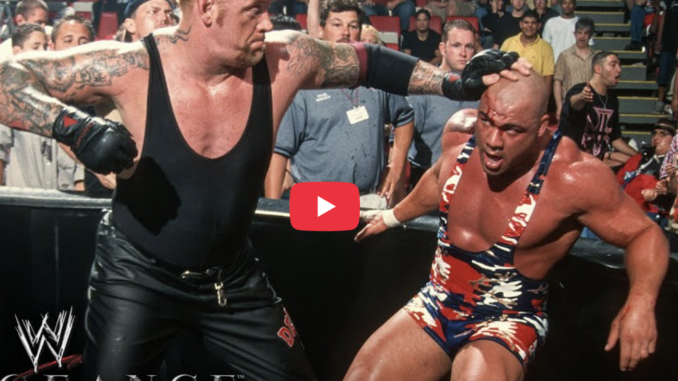
Then: The Rock vs. Kurt Angle vs. The Undertaker (WWF Vengeance: July 21, 2002)
Chaos is the one word that could describe the WWF Championship picture during the first eight months of 2002. By the time Brock Lesnar won the championship at SummerSlam, he had become the sixth WWE Champion of the calendar year. Some chaos is good because it creates unpredictability and a sense that anything can happen. However, too much chaos can be detrimental. When the boat is constantly rocking, it’s hard to stay on your feet and pay attention.
In the wake of all the turmoil in the main event scene, WWE booked a surprising triple threat match for the championship, with The Undertaker defending against Kurt Angle and a returning Rock. By 2002, the triple threat match was no longer a novelty, but it was still infrequent enough to feel special. On this occasion, the three competitors delivered a special match.
The match follows the familiar triple threat format of two wrestlers in the ring while the third is temporarily out of the action, with the pairings switching on multiple occasions. The two-in, one-out format also allows the wrestlers to maintain a frantic pace from the opening bell to the closing moments. The constant action stirs the fans into a frenzy, but one of the potential shortcomings of triple threat matches is that the relentless pace can come at the expense of character development. With so many moving parts, it can be difficult to give each wrestler enough time to establish a distinct personality beyond executing moves.
That isn’t a problem here.
All three wrestlers get opportunities to shine, not only through their offense but also through their individual personalities. The constant swings in momentum and transitions between big moves keep the fans on the edge of their seats, and by the end, the crowd is in a frenzy. Every near fall feels as though it could decide the championship.
None of the competitors is able to maintain control for long, and the match never settles into a predictable rhythm. One of the things that made this match stand out at the time was the relatively rare sight of wrestlers stealing one another’s finishers. While that has become commonplace in contemporary wrestling, this was one of the earliest examples I can remember seeing in WWE. The closing sequence is particularly effective. The Rock nails Kurt Angle with a Rock Bottom and scores the pinfall just before The Undertaker can break it up.
This was an early example of the triple threat match at its best. To my memory, by the summer of 2002, it was the best triple threat match WWE had produced.
Now: Naomi vs. Rhea Ripley vs. Iyo Sky (WWE SummerSlam: August 3, 2025)
When two opponents already have great chemistry, adding a third element can sometimes be a disadvantage. In these cases, introducing another wrestler can diminish the explosiveness and excitement of a contest. In other situations, however, adding a third person to a rivalry creates a different dynamic. The new match doesn’t necessarily have to match the in-ring quality of the original two competitors to be special and worthwhile.
The triple threat match between Naomi, Rhea Ripley, and IYO SKY at SummerSlam 2025 falls into the latter category. The previous month, Rhea and IYO had reaffirmed their fantastic chemistry with one of the best women’s wrestling matches in WWE history at Evolution. That match ended with Naomi cashing in her Money in the Bank contract and walking away as WWE Women’s Champion. Logically, this led to a triple threat match at SummerSlam.
While this contest doesn’t reach the heights of the fantastic singles match between IYO and Rhea, it offers enough differences to stand out on its own. From the opening bell, Naomi demonstrates the different element she brings to the match. Her new cutthroat, clever-as-a-fox, slightly unhinged character allows her to control the early stages of the contest while keeping both Rhea and IYO at bay.
The second chapter of the match features Rhea and IYO teaming up to dispose of Naomi. This leads to a revisit of the tremendous chemistry between Rhea and IYO, as the two exchange several impressive sequences that add excitement to the contest.
In the third chapter, we get the familiar two-in, one-out exchanges, with all three wrestlers becoming involved in the transitions. Naomi’s presence changes the dynamic and adds another layer of intrigue. At any moment, she can break up a pinfall to save her championship, meaning that even when Rhea and IYO have the upper hand, neither can afford to lose track of the champion.
As for the finish, it’s well executed, although perhaps a little overdone. The biggest move of the match comes when Rhea hits a Riptide on IYO from the top rope. As Rhea positions herself to score the pinfall, Naomi sneaks up from behind, rolls Rhea into a schoolboy, holds the tights, and steals the victory to retain her championship.
This is a great example of how a triple threat match doesn’t have to match the chemistry or in-ring performance of a singles match to stand out and justify the stipulation. By introducing a different personality and a new dynamic, Naomi adds something to the match that wouldn’t have been possible in another Rhea-IYO singles encounter.
Forever: Brock Lesnar vs. John Cena vs. Seth Rollins — Royal Rumble 2015
When discussing the best triple threat matches of all time, two groups of three wrestlers immediately come to mind. The first is Shawn Michaels, Triple H, and Chris Benoit, who delivered memorable triple threat matches at WrestleMania XX and Backlash a month later. The second is AJ Styles, Samoa Joe, and Christopher Daniels, who had two outstanding triple threat matches in TNA.
While it might not quite reach those heights, another fantastic triple threat match took place at the 2015 Royal Rumble, featuring Seth Rollins, John Cena, and Brock Lesnar.
In the months leading up to the match, Cena and Lesnar had faced each other multiple times, as had Cena and Rollins. Given how frequently these matchups had occurred, fans might not have been particularly excited about seeing another variation of either pairing. However, mixing all three competitors together created a unique and special contest.
At the beginning of the match, we see Brock Lesnar at his dominant best, destroying both Cena and Rollins, as well as Rollins’ security team. At this stage, the match feels like a typical Brock Lesnar performance. He’s an unstoppable force, and neither opponent appears capable of slowing him down.
The match changes dramatically when Cena and Rollins independently begin working to take out the Beast. Their efforts culminate in Lesnar absorbing multiple finishers before Rollins delivers a beautiful elbow drop from the top rope to the outside, crashing through a table with Lesnar below.
From there, we essentially get a singles match between Rollins and Cena. The two execute their trademark sequences, with meaningful transitions, momentum shifts, and twists and turns along the way. The work is so good that it’s easy to forget Lesnar is even involved, despite the camera occasionally cutting to the medical personnel attending to him on the outside.
At this point, it appears that Lesnar is out of the match for good. Then, after Rollins hits a Phoenix Splash seemingly out of nowhere, Lesnar reenters the ring, hauls Rollins off the cover, and delivers a German suplex. The fans go nuts.
WWE could easily have had Lesnar hit a finishing move and win at this point, but instead, the match delivers another excellent twist. Rollins uses his Money in the Bank briefcase to take Lesnar down and launches a late rally, briefly making the outcome feel uncertain once again. Eventually, Lesnar catches Rollins, hoists him up, and delivers the F-5 to win the match.
This is a fantastic example of a triple threat match in which the whole is greater than the sum of its parts. Rather than simply giving us another singles match involving any combination of these three wrestlers, the stipulation creates something significantly better. Lesnar’s dominance, Cena’s resilience, and Rollins’ opportunism all serve a purpose, and the match continually changes direction without sacrificing its underlying story.
That’s what a great triple threat match should accomplish. It shouldn’t simply put three wrestlers in the ring and give them an excuse to perform more moves. It should use the presence of all three competitors to create something that couldn’t be replicated in a singles match. The 2015 Royal Rumble main event does exactly that.