
SPOTLIGHTED PODCAST ALERT (YOUR ARTICLE BEGINS A FEW INCHES DOWN)...
This June marks 20 years since the second ECW One Night Stand and 21 years since the original ECW One Night Stand in 2005. For me, ECW will always hit the nostalgia button.
I was first exposed to Extreme Championship Wrestling as a teenager. Looking back, discovering ECW felt a lot like discovering a new band. The sound is familiar enough that you recognize its influences, but it is presented in a fresh, edgy way that feels different from everything else. You can’t wait to tell your friends about it, yet a small part of you wants to keep it a secret so it remains yours. That was my experience with ECW.
I first discovered the promotion in 1997. In Utah, ECW aired late on Saturday nights on Network One, and I often had to rearrange the rabbit ears on my television just to get a clear picture. The product was gritty, rebellious, and unlike anything I had seen before. If I had to choose one word to describe ECW, it would not be “extreme,” it would be “excessive.”
The violence was excessive. The blood was excessive. The weapon use was excessive. The sexual content was excessive. The high-risk moves were excessive. For a 15 year old kid, that was exactly the appeal. If you had asked me at that age how much blood, violence, sex, or high-flying action I wanted, my answer would have been simple: More. Teenagers often equate excess with excitement. With limited impulse control and an underdeveloped sense of perspective, bigger almost always feels better.
The problem with nostalgia is that it tends to preserve only the highlights. When the WWE Network launched in 2014, I revisited many of the old ECW Hardcore TV episodes and pay-per-views. To my surprise, the product was not quite as great as I remembered. Much of what had seemed groundbreaking as a teenager now felt desperate and underdeveloped.
As a wrestling fan in my 40s, I view excess differently. Too many weapons, too much blood, and an endless stream of highspots often feel less exciting and more like attempts to compensate for weaknesses elsewhere. The older I get, the more I appreciate wrestlers who can generate crowd reactions through timing, storytelling, psychology, and flawless execution of the fundamentals.
That is one reason why the One Night Stand pay-per-views felt so magical. The presentation provided a carefully curated version of ECW that highlighted the promotion’s greatest strengths while minimizing many of its weaknesses. The atmosphere was electric, the audience was passionate, and the performers were motivated to prove that ECW still mattered.
I often compare the One Night Stand events to Woodstock. At the time, many people viewed Woodstock as the beginning of something new. In reality, it represented the peak of a movement just before its inevitable decline. One Night Stand captured the spirit of ECW at its most memorable, but it also served as a reminder that the promotion’s greatest days were already behind it.
Unfortunately, the ECW relaunch could not sustain that magic. At the time, many fans – including myself – blamed WWE creative. Looking back, I am not convinced any creative team could have recreated what made ECW special. The relaunch felt like a reunion tour from a beloved band. Fans desperately want the group to get back together and play the hits. But when the band releases new material, the riffs are no longer as innovative, the energy feels diminished, and the result is often a lesser version of something that was once great.
Today, I believe I have a more balanced understanding of ECW and its legacy. I can appreciate the promotion’s creativity, passion, and influence while also recognizing its flaws and shortcuts. In many ways, accepting those shortcomings has allowed me to enjoy ECW more honestly than I did as a teenager.
In this week’s article, I will look back at some of my favorite memories and the lasting legacy of Extreme Championship Wrestling.
Then: Sabu vs. Taz, Taz vs. Shane Douglas (Wrestlepalooza 1997)
Three of the wrestlers I most closely associate with the height of ECW are Sabu, Taz, and “The Franchise” Shane Douglas.
There may never have been a wrestler as believable as Sabu. His persona was that of a maniac who was just as dangerous to himself as he was to his opponents. Even after wrestling Sabu myself in 2005, I was never entirely sure what was an act and what was real. The same uncertainty existed in his matches. I never knew when Sabu was selling and when Sabu was genuinely hurt.
As wrestling fans, we often judge selling based on performance rather than believability, forgetting that the entire purpose of selling is to convince the audience that pain is real. Sabu sold taking offense from his opponents just as convincingly as he sold delivering offense himself. The fans never knew if he was actually injured. Because of that uncertainty, every Sabu match carried an extra level of investment, fueled by equal parts fear and excitement.
Taz and Shane Douglas serve as case studies in the importance of unwavering, consistent presentation. Taz was portrayed as a total badass. His legitimacy was emphasized and connected to the emerging world of mixed martial arts long before MMA became mainstream. ECW programming sold the idea that Taz could legitimately beat anyone in a fight, and I bought it.
Likewise, ECW relentlessly presented Shane Douglas as “The Franchise” and the centerpiece of the promotion. Every promo, every feud, and every appearance reinforced his status as a main-event star. The presentation was laid on thick, and I bought that too.
The follow-up event to ECW’s first pay-per-view, Barely Legal, was Wrestlepalooza 1997. All three men – Sabu, Taz, and Shane Douglas – are featured prominently during a memorable sequence at the ECW Arena. The segment showcases another part of ECW’s secret sauce: fast-moving television that blended matches, promos, and storylines together in a way that felt organic and unpredictable. The pace created an atmosphere of chaos and excitement that often left fans feeling like they had received far more than they bargained for.
In the opening match, Taz challenged Sabu to a rematch from Barely Legal. Though relatively short, the contest highlighted Sabu’s trademark high-risk offense and Taz’s devastating suplexes. The finish came suddenly when Sabu reversed his weight during the Tazmission and scored a quick pinfall victory. Taz protected his aura by immediately attacking referees and officials after the match, making it clear that a pinfall loss meant far less to him than choking out his opponent.
Moments later, Shane Douglas appeared from the “Crow’s Nest” (an off-featured balcony) and issued a challenge to Taz, who gladly accepted. Suddenly, the audience was treated to an impromptu ECW World Television Championship match. Taz forced Douglas to submit, further cementing his reputation as the most dangerous man in ECW.
The entire sequence lasts roughly 30 minutes and perfectly captures what made ECW special. Fans who walked into the building expecting a straightforward rematch between Taz and Sabu ended up witnessing two matches, multiple storyline developments, and a dramatic shift in the ECW landscape. It was unpredictable, chaotic, and immensely entertaining – everything that ECW at its best was supposed to be.
Now: ECW Originals ( Tommy Dreamer & The Dudley Boys & Rhyno) vs. The Wyatt Family: Elimination Table Match (WWE TLC 2015)
More than a decade after the failure of WWE’s ECW relaunch, chants of “ECW! ECW! ECW!” could still be heard periodically on weekly wrestling television. It wasn’t until relatively recently – perhaps in the post-pandemic era – that those chants finally began to fade away.
More often than not, the chants were connected to a particular spot, wrestler, or style; sometimes all three. In truth, they often felt less like reactions to what was happening in the moment and more like tribute nods to fond memories of the past. Sometimes those tributes felt earned and appropriate. Other times they were a bit eye-roll inducing.
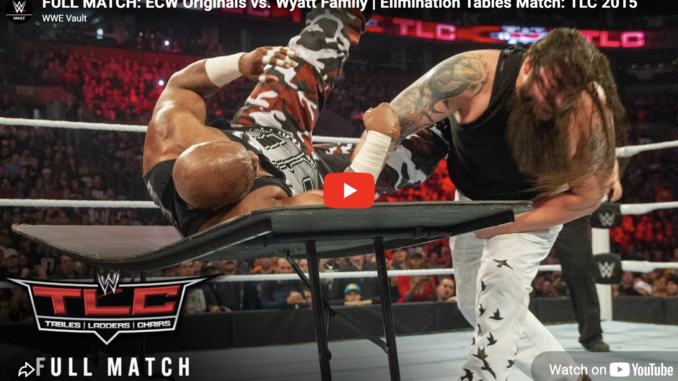
One of the later examples of an ECW tribute match took place at TLC 2015, when a team of ECW originals consisting of Tommy Dreamer & The Dudley Boyz & Rhyno against The Wyatt Family in an elimination tables match. While the bout firmly fits within WWE’s version of hardcore wrestling— – which tends to be more fun than genuinely dangerous – it still provides glimpses of the spirit that made ECW special.
The action is messy, chaotic, and energetic. Weapons, brawling, and creative use of tables are on display throughout, all delivered in a crowd-pleasing fashion. Just as importantly, the ECW veterans demonstrate a strong understanding of how hardcore wrestling should be structured. Years of experience allow them to use weapons and big spots not simply for spectacle, but as momentum shifts within the match. The result is a contest that often resembles a team sport. Viewers can clearly identify which side is in control, which side is mounting a comeback, and when the tide begins to turn toward the eventual winners.
This match does not attempt to reinvent the wheel or redefine hardcore wrestling for a new generation. Instead, it serves as a celebration of a style that ECW helped popularize. It gives fans one more opportunity to rally behind the ECW originals while opposing a Wyatt Family unit that was rapidly establishing itself as one of WWE’s most dominant acts.
Looking back, the match feels like one of the final meaningful tributes to ECW on a major stage. The chants, the weapons, the familiar faces, and the atmosphere all combined to provide fans with one last reminder of what made ECW resonate so strongly in the first place.
Forever: Rob Van Dam vs. Jerry Lynn (Hardcore Heaven 1999)
The best – and my favorite – matches from ECW were those between Rob Van Dam and Jerry Lynn.
Rob Van Dam had the elusive “it factor.” Exactly what that factor was is difficult to define, but it was a combination of several elements. His athletic style and moveset blended innovation and violence in a way that was unmatched by his peers and nearly impossible to replicate. Moreover, he carried a cooler-than-you attitude that fused surfer, showoff jock, and stoner into a persona that was completely unique.
As for Jerry Lynn, the words “underrated” and “underappreciated” immediately come to mind. His precision, execution, technical ability, smoothness, and believability were on par with talents such as Dean Malenko, Chris Benoit, and Eddie Guerrero, yet he is rarely discussed at that level. Jerry Lynn had a remarkable ability to make his opponents better, and in the case of Rob Van Dam, he was the perfect dance partner – one who emphasized and highlighted RVD’s greatest strengths.
Rob Van Dam always delivered innovative and visually spectacular offense. I would contend, however, that he was not always as effective at connecting individual spots into a cohesive match narrative. This is where Jerry Lynn’s value became indispensable. Lynn’s smooth counters, transitions, and timing elevated cool moves into memorable sequences. The chain of reversals and counters leading to a big move made that move feel more meaningful, creating matches that felt competitive, dramatic, and believable.
Competition, danger, toughness, athleticism, and violence are all on display in this contest. Extra respect is owed to Lynn, who, after taking a frightening face-first fall to the floor and legitimately knocking himself silly, continued to battle through the remainder of the match despite clearly being compromised.
Another aspect of the RVD-Lynn rivalry that deserves recognition is its influence on modern professional wrestling. They were not the first wrestlers to perform the now-common opening-match standoff sequence, but they helped popularize it to the point that fans can see some variation of it nearly every week on televised wrestling.
Likewise, while WCW’s cruiserweight division was showcasing the speed and athleticism of smaller wrestlers, RVD and Lynn emphasized the impact and violence of high-flying wrestling. Their matches demonstrated that aerial offense could be more than flashy – it could be physical, dangerous, and believable enough to headline major events. In many ways, they helped pave the way for a generation of wrestlers who combined high-flying athleticism with heavyweight-level intensity.
When you look at many of today’s top stars, such as Will Ospreay, Seth Rollins, and “Hangman” Adam Page, you can see elements of that influence. They perform breathtaking aerial maneuvers, but they do so in a way that feels impactful and worthy of a main event. Long before that style became commonplace, Rob Van Dam and Jerry Lynn were helping to define what it could look like.
Leave a Reply
You must be logged in to post a comment.