
SPOTLIGHTED PODCAST ALERT (YOUR ARTICLE BEGINS A FEW INCHES DOWN)...
It used to be that the hardest part of being a wrestling fan was explaining to your friends why you were watching grown men in spandex simulate a fight. Today, the real challenge isn’t the outside judgment – it’s the house itself. What was once a community built on the shared joy of “larger-than-life” spectacles has fractured into a minefield of tribalism, where “gatekeeping” has become a competitive sport and every booking decision is treated like a personal insult.
For a new fan just trying to figure out who the champions are, or a casual viewer who just wants to turn their brain off for two hours on a Monday night, the modern landscape is exhausting. Between the constant “bad-faith” arguments on social media and the demand to know every backstage rumor just to join a conversation, we’ve created a culture that is so busy protecting its “hardcore” status that it has forgotten how to actually welcome anyone else to the show.
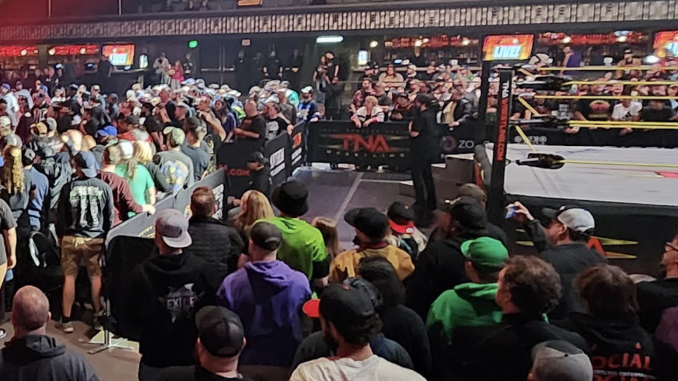
In the 2020s, professional wrestling has experienced a strange paradox: while the athleticism in the ring has never been higher, the culture outside the ring – the fandom – has arguably never been more alienating.
For many who grew up during the “cool” eras of the ’80s and ’90s, today’s wrestling community feels less like a rowdy stadium crowd and more like an obsessive, hyper-fixated online subculture. Here is a look at how wrestling fans have changed in the modern era and what the fandom has lost along the way.
(1) The Death of the “Casual Cool”
In the late-’90s, wrestling was a mainstream fashion statement. You could wear an “NWO” or “Austin 3:16” shirt to a bar, a mall, or a gym and be seen as part of the zeitgeist. Today, that “casual cool” is gone. Wrestling fans in the 2020s are often viewed as a niche group of “super-consumers.” The fandom has become increasingly insular, filled with people who don’t just watch the show, but obsess over contract statuses, backstage politics, and “star ratings.” To the average person, this level of fixation feels more like “weird” gatekeeping than a fun hobby.
(2) From Fans to “PhDs of Booking”
One of the strangest shifts is that fans no longer seem to want to be entertained; they want to be the ones doing the entertaining.
- The “Smart Mark” Era: Modern fans are often more interested in “work rates” and “backstage heat” than the actual stories being told on screen.
- Performance Critiques: Instead of cheering for a hero, fans at live shows often spend the time trying to get themselves over with “ironic” chants or criticizing the choreography.
- The Loss of Magic: By knowing every secret behind the curtain, the modern fan has killed the “suspense of disbelief” that made wrestling special.
(3) Toxic Tribalism and the “Brand Wars”
The 2020s introduced a new level of “strange” behavior: corporate tribalism. With the rise of AEW as an alternative to WWE, the so-called Internet Wrestling Community (IWC) has splintered into warring factions.
- Social Media Toxicity: Fans will spend hours arguing about television ratings (Nielsen numbers) as if they are stockholders in the company.
- Hating Over Celebrating: It’s common to see “fans” spend more time rooting for a rival company to fail than actually enjoying the show they claim to love. This constant negativity makes the fandom feel like a hostile environment rather than a community.
(4) The “Parasocial” Problem
The 2020s fan has become increasingly invasive. Because of social media, fans feel they have a direct line to wrestlers’ personal lives. This has led to “weird” and often creepy behavior:
- Airport Stalking: Fans tracking flight schedules to ambush tired wrestlers at 4:00 a.m. for autographs.
- Personal Attacks: Sending death threats or vitriol to performers over scripted storylines.
- Entitlement: A sense that because they “pay for the product,” they own the performers’ private time.
ARTICLE CONTINUED BELOW…
Check out the latest episode of the “All Elite Conversation Club” with Joel Dehnel and Gregg Kanner, part of the PWTorch Dailycast line-up: CLICK HERE to stream (or search “pwtorch” on Spotify, Apple Podcasts, or any other iOS or Android app to subscribe free)
What Has Been Lost?
Ultimately, the wrestling fandom has lost its joy. The 2020s fan is often so busy being a critic, a statistician, or a “troll” that they forget to just be a fan. The feeling of a packed arena collectively losing their minds because a “glass shattered” or a “gong sounded” has been replaced by a crowd that is too busy checking their phones to see what the internet thinks of the match they are currently watching. Wrestling used to be about the escape. Today, for many, it’s just another battleground for online arguments.
Media Is Not Helping, Just Hurting
Ultimately, the rise of modern wrestling toxicity isn’t just a grassroots problem; it is a fire stoked daily by a media apparatus that often finds more profit in division than in education. Rather than acting as a bridge for the uninitiated, many “dirt sheets,” podcasters, and YouTube pundits have leaned into the role of tribal agitators, prioritizing clicks from the most fervent, “smart-mark” circles over the health of the broader industry.
By weaponizing backstage rumors and validating bad-faith arguments, these outlets have helped turn wrestling into a dense, insider-only club that treats casual curiosity like a weakness.
Worse yet, by playing to the blind fandom of the hardcore base to keep subscription numbers high, they have abdicated their responsibility to actually inform. Instead of calling out the gatekeepers or explaining the logistical “how’s” and “whys” of the business – like the reality of TV rights, the necessity of broad-appeal storytelling, or the physical toll of the schedule – they echo the loudest voices in the echo chamber. In doing so, wrestling media hasn’t just documented the toxicity; it has packaged and sold it, leaving the casual viewer stuck at the gate while the “experts” and the “hardcore” argue over the keys to a house that’s becoming increasingly lonely.
The Ending
If professional wrestling is ever going to experience another true “boom period,” it won’t be because of a five-star match or a shocking backstage scoop – it will be because the community finally decided to lower the drawbridge. We are currently stuck in a self-defeating cycle where the media feeds the tribalism, the hardcores police the gates, and the casual fans simply walk away to find entertainment that doesn’t require a prerequisite course in “inside baseball.”
Wrestling is at its best when it is a universal language, a spectacle that can be enjoyed by a five-year-old seeing a hero for the first time just as much as a thirty-year veteran of the tapes. To save the soul of the sport, the fandom and the media that covers it must trade the exhaustion of constant outrage for the simple thrill of the show.
We have to stop treating “casual” like a four-letter word and start remembering that every “hardcore” expert started out exactly the same way: as a newcomer who just wanted to see what all the noise was about. Until we stop gatekeeping the circus, we shouldn’t be surprised when the tent starts feeling smaller and smaller.
(You can submit a guest editorial for consideration to be published at PWTorch by sending to PWTorch’s editor Wade Keller at kellerwade@gmail.com.)
Leave a Reply
You must be logged in to post a comment.