
SPOTLIGHTED PODCAST ALERT (YOUR ARTICLE BEGINS A FEW INCHES DOWN)...
The 39th SummerSlam is now in the books. Before every major WWE premium live event, fans debate which match has the potential to steal the show. Once the final bell rings, the conversation shifts to which wrestlers delivered the standout performance and which match ultimately exceeded every expectation.
One aspect of WWE’s presentation that I appreciate is that not every match is designed to steal the show. Not every bout is given the time, the platform, or the creative freedom to become the centerpiece of the event. Other promotions often encourage every wrestler to do everything possible to stand out, resulting in shows that become excessive—too many high spots, too many false finishes, too much blood, and matches that overstay their welcome. When every match is trying to be the most memorable, the moments that truly deserve to stand out often lose their impact.
WWE generally identifies two or three matches on a major card as legitimate contenders for Match of the Night. Whether those matches actually steal the show depends on several factors. Strong momentum and compelling storytelling heading into the event create anticipation. Once the bell rings, the action must be crisp, the story easy to follow, and the pacing deliberate. Sometimes a single unforgettable moment or spectacular move elevates a match from great to legendary. Finally, nothing enhances a wrestling match more than an invested live crowd. The energy inside the arena can transform an excellent match into one that feels like the most important thing happening in the world.
This week, I’ve selected three matches from the SummerSlam archives that stole the show at their respective events. While each did so for different reasons, all three left a lasting impression that outshined everything else on the card.
Then: The Rock vs. Triple H (Summerslam 1998)
The WWF was white hot on the “Highway to Hell” leading into SummerSlam 1998. The characters were connecting with fans at an incredible level, and the weekly television was must-see viewing. I almost hesitate to revisit this era because I’m afraid reality won’t live up to my memories. Watching in real time, however, the excitement surrounding the company and SummerSlam itself felt enormous. The video packages, television commercials, graphics, entrance music—everything clicked. Add the fact that the event took place in the legendary Madison Square Garden, the spiritual home of the WWF, and the entire show carried an atmosphere that felt bigger than life.
Stone Cold Steve Austin defending the WWF Championship against The Undertaker was the marquee attraction heading into the event. By the end of the night, however, the match receiving the most praise was the Intercontinental Championship Ladder Match between two rising stars, Triple H and The Rock. Ever since Rocky Maivia debuted at Survivor Series 1996, the two had been intertwined. By the summer of 1998, they had become the leaders of the WWF’s two most prominent factions—D-Generation X and the Nation of Domination—and fans recognized both as future main event stars. Their SummerSlam ladder match proved to be the breakthrough performance each man needed.
Unlike many of today’s ladder matches, which often revolve around increasingly elaborate stunts, this contest is fundamentally a grudge match built on traditional wrestling psychology. The ladder is used primarily as a weapon and as the means to win the match, not as a prop for spectacular dives. The drama comes from each wrestler’s struggle to climb the ladder and retrieve the championship rather than from anticipating the next dangerous high spot.
That isn’t to say the match lacks brutality. The Rock viciously targets Triple H’s injured knee with the ladder, while Triple H absorbs several painful-looking bumps throughout the contest. The punishment, combined with The Rock’s ruthless tactics, turns Triple H into a sympathetic babyface whose toughness and determination earn the audience’s support.
Perhaps the greatest testament to the match is the crowd’s reaction. Despite the heated rivalry, the audience is surprisingly subdued during the opening minutes. Rather than relying on the storyline alone, Triple H and The Rock gradually earn the crowd’s investment. The intensity steadily builds until the audience reaches a fever pitch during a brilliantly executed double-down sequence. Triple H is shoved from the ladder into another ladder propped in the corner, only to rebound in desperation and tip over the ladder The Rock is climbing. It’s a unique sequence that perfectly captures the desperation of both competitors and leaves the crowd buzzing with anticipation.
The finish comes after Nation of Domination member Mark Henry interferes, throwing powder into Triple H’s eyes and leaving him blinded as he desperately searches for the ladder. As The Rock climbs toward the Intercontinental Championship, Chyna storms to the ring and delivers a low blow, sending The Rock crashing back to the canvas in agony. Still unable to see, Triple H slowly feels his way up the ladder and retrieves the championship. It isn’t a conventional babyface victory, but after Henry’s interference and The Rock’s relentless heel work throughout the match, the ending feels earned rather than contrived.
Any biography chronicling the careers of Triple H or The Rock would highlight this match as a defining turning point. It elevated both men from promising young stars to legitimate main event players. For The Rock, it was one of the key stepping stones on a journey that would ultimately lead to global superstardom beyond professional wrestling. SummerSlam 1998 proved that on the biggest stage, you don’t have to be in the main event to become the biggest story of the night. Sometimes, stealing the show is what launches a superstar to the next level.
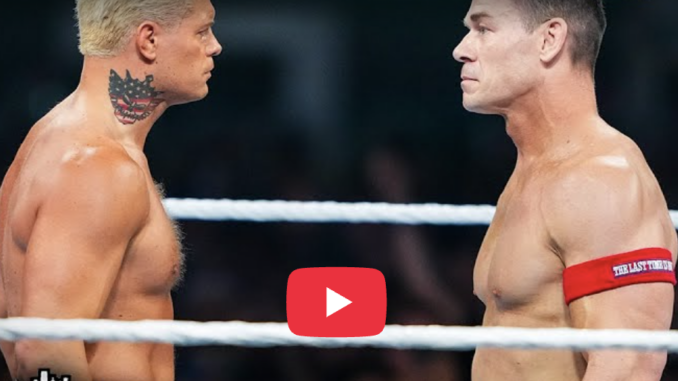
Now: John Cena vs. Cody Rhodes (Summerslam 2025)
One of my biggest complaints about modern professional wrestling is excess. Excessive match length, excessive high spots, excessive kickouts, excessive finishers, excessive violence—everything is bigger, longer, and louder than it needs to be. I continue to criticize this trend because I believe it is a silent killer of the audience’s emotional investment. It numbs fans to the fundamental elements that make professional wrestling compelling. More importantly, it creates an environment where wrestlers are constantly doing more while making everything they do mean less.
That said, there is a time and place for excess.
Those moments should be reserved for the biggest matches on the biggest stages, when the story has been carefully built and the audience has been conditioned to believe they are witnessing something extraordinary. Cody Rhodes versus John Cena at SummerSlam 2025 was one of those rare occasions. It was a match that deserved to embrace excess, and that’s exactly what it did.
By the summer of 2025, it had become painfully obvious that John Cena’s heel run wasn’t working. His shocking heel turn initially generated tremendous excitement, but the momentum quickly faded. Some of the blame falls on uninspired creative, but much of it stemmed from the simple reality that WWE fans didn’t want to spend Cena’s farewell tour booing him. They wanted one last run with “Super Cena.” The character that had frustrated so many fans throughout the late 2000s and early 2010s had somehow become the version they most wanted to celebrate. Days before SummerSlam, Cena abandoned the heel persona and promised that fans would get the old John Cena in his No Holds Barred showdown with Cody Rhodes. They got the old Cena—and then some.
ARTICLE CONTINUED BELOW…
Check out the latest episode of “Worse or Better” with Stephanie Chase and Josh White, part of the PWTorch Dailycast line-up: CLICK HERE to stream (or search “pwtorch” on Spotify, Apple Podcasts, or any other iOS or Android app to subscribe free)
One of the biggest flaws of Cena’s heel run was that it stripped away everything that traditionally made a John Cena match exciting. The explosive comebacks, the exaggerated babyface selling, the sudden momentum swings, and the dramatic bursts of energy were all gone. In their place was a deliberately methodical style that lacked urgency and emotion. He wrestled cautiously. His movements appeared tentative, his bumps were careful, and his offense lacked conviction. Whether that was intentional or simply the reality of a veteran nearing retirement, the result was the same. It was difficult to watch because it no longer felt like John Cena.
At SummerSlam, that version disappeared.
In his place was the best version of Super Cena he could still deliver. The intensity returned. The larger-than-life facial expressions and animated selling were back. The signature comeback was back. And yes, so were the superhuman kickouts, multiple finishers, dramatic momentum swings, and improbable near falls that had defined so many of his biggest matches.
Was it excessive? Absolutely.
But this was one of those rare cases where the excess served the story instead of distracting from it. Cody Rhodes matched Cena’s energy every step of the way, and every finisher, every kickout, and every dramatic reversal felt driven by a singular purpose: the desire to leave SummerSlam as WWE Champion. Rather than feeling like spectacle for spectacle’s sake, the excess felt earned because it reinforced the importance of the match.
Ideally, the match that steals the show should be the main event. The lasting impression of a premium live event is often determined by whether the closing match meets, exceeds, or falls short of expectations. WrestleMania 41’s main event between Cody Rhodes and John Cena failed to live up to the enormous hype surrounding it, leaving a cloud hanging over an otherwise memorable weekend. Four months later, those same two men erased that disappointment. Their SummerSlam rematch delivered the kind of over-the-top, emotionally charged main event worthy of closing WWE’s second-biggest event of the year. Sometimes less is more in professional wrestling. But when the moment truly calls for it, excess can create something unforgettable.
Forever: Shawn Michaels vs. Triple H (Summerslam 2002)
The best wrestling stories take fans on an emotional roller coaster. We see the action, hear the crowd’s reaction, and feel the story unfolding in the ring. Few matches have ever taken me on that kind of journey quite like Shawn Michaels’ return after a four-year hiatus to face his former best friend, Triple H, at SummerSlam 2002.
Heading into the match, I felt an unusual combination of excitement and fear. I was thrilled to see one of my favorite wrestlers return to the ring after an injury that, just a few years earlier, seemed certain to end his career. At the same time, I was genuinely concerned. First, I feared Shawn was risking his long-term health. WWE had done such an effective job telling the story on television that I completely bought into the idea that he might be putting himself in danger. Even more than that, I worried that the Shawn Michaels of 2002 would be only a shadow of the “Heartbreak Kid” who had revolutionized wrestling throughout the 1990s. Could anyone live up to that legacy—especially Shawn himself? Those concerns only intensified during the week before SummerSlam, when Michaels attempted a dive over the top rope during a television brawl and came up frighteningly short, making his return feel even more uncertain.
When Shawn walked to the ring wearing jeans for the unsanctioned match, my expectations dropped even further. He looked like a man arriving for a fight, not “The Showstopper” preparing to steal the show. Yet from the opening moments, that anxiety began to give way to hope. Shawn threw punches like the old Shawn Michaels. He launched himself into a picture-perfect plancha over the top rope. Then came the Skin the Cat. The phrase “You still got it!” hadn’t become a wrestling cliché yet, but that was exactly what every fan inside the Nassau Coliseum was thinking.
That hope comes to a screeching halt when Triple H delivers a perfectly executed backbreaker and begins a prolonged assault. This is where Triple H is at his best—methodical, ruthless, and completely without compassion. Michaels is equally outstanding. His selling creates tremendous sympathy while his brief bursts of offense keep hope alive without ever feeling unrealistic. Even referee Earl Hebner becomes an important character in the story. His attempts to stop Triple H from using the sledgehammer momentarily pull him out of the role of official and remind the audience that there is still a sense of humanity amidst the violence, making the match feel even more believable.
The emotional turning point arrives when Shawn delivers a desperation low blow before following it with Sweet Chin Music that sends Triple H crashing into a steel chair, busting him open. Suddenly the momentum shifts. Michaels follows with his signature flying forearm, kips up to his feet, and the arena erupts. It feels less like a comeback than a resurrection.
From there, Michaels unleashes an offensive barrage using both weapons and the trademark offense that made him one of the greatest performers of all time. At this point, the audience’s mindset changes from, “He looks like the old Shawn Michaels,” to, “He is the old Shawn Michaels.” Jim Ross and Jerry “The King” Lawler deserve tremendous credit as well. Rather than trying to manufacture excitement, they allow themselves to be swept away by the emotion of the moment. It remains one of the finest calls of their legendary partnership.
The closing minutes continue to toy with the audience’s emotions. Michaels delivers a flawless elbow drop from the top of a ladder before tuning up the band for one final Sweet Chin Music. Every fan is on their feet in anticipation. After a series of perfectly timed counters Shawn reverses a Pedigree into a jackknife pin for the three-count. As “Sexy Boy” fills the arena, the building explodes. It is one of the most magical moments in SummerSlam history.
Then, just as quickly, that joy is ripped away. After the match, Triple H viciously drives a sledgehammer into Shawn’s back, spoiling the celebration in one final act of bitterness. It remains one of the most despicable displays of being a sore loser in WWE history.
SummerSlam 2002 is one of the greatest SummerSlam events WWE has ever produced. On a card overflowing with talented performers, memorable moments, and outstanding wrestling, Shawn Michaels and Triple H still managed to stand above the rest. They didn’t steal the show solely because of their technical excellence or brutal in-ring performance. They stole it because they made the audience feel every emotion imaginable. Hope. Fear. Doubt. Joy. Triumph. Heartbreak. That emotional journey is what transformed an excellent match into an unforgettable one.
Leave a Reply
You must be logged in to post a comment.