
SPOTLIGHTED PODCAST ALERT (YOUR ARTICLE BEGINS A FEW INCHES DOWN)...
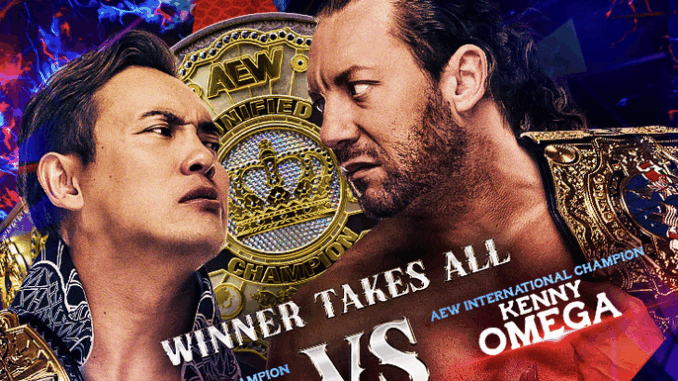
Saturday at AEW “All In,” the dawning of the AEW Unified Championship happened, as two championships were combined into one.
The International Championship has had its times where it has been seen as important, but it was often the title that I never felt found its place. Starting as the All-Atlantic Championship, it was a title that would be defended in other continents. It was a confusing name and was quickly rechristened the International Championship. It had strong relevance when Orange Cassidy held it the first time.
His continual defenses, followed by him being drained going into his next defense was the best Orange and this title were ever used. Cassidy put a lot of credibility into that title before losing it to Jon Moxley. Not an undercard heel needing to get to the next level as a character, but a former world champion. Did Cassidy lose because he was too beat up, or because Mox is better? The title lost its magic. They tried putting lightning back into a bottle, but Cassidy couldn’t create the same effect on a second run.
The Continental Championship has a much shorter lineage. Created as a new AEW Championship in match rules that let zero interference of any kind happen within their matches. It was going to be combined with the ROH Championship and NJPW Strong Championship as a modern Triple Crown Championship. That fell apart when they’d have a belt from NJPW on the recently departing Kazuchika Okada. Eddie Kingston, who was the first holder of the championship had to individually lose each championship before losing the Continental Title to Okada. Okada had the title going into the match, and dominantly so.
With neither title hot enough to call a draw themselves, and way too many titles within four hours of weekly programming for the promotion, the decision was made to make the big rematch with Kazuchika Okada vs. Kenny Omega winner takes all. The hope is that the hype of the match and the combining of the championships launches a title with built in prestige. It will be the choices made after All In that will ultimately decide the level of prestige that title holds.
With two titles combining into one, it is something we’ve seen in wrestling history’s past where one or both of those belts disappeared. Here are five championships lost into unifications.
WCW World Heavyweight Championship
A case could certainly be made that the World’s Heavyweight Championship that Gunther and Goldberg will be competing over is vaguely connected to the WCW World Heavyweight Championship. Similar in look to the “Big Gold” belt that WCW once recognized, it came to WWE by way of Vince Mcmahon’s purchase of WCW. Its linage has been a mess for years. When WCW was created, they recognized the NWA Heavyweight Champion as their champion. They were simply the “World’s Heavyweight Champion.”
Then Ric Flair left with the belt. WCW ended up creating a new title belt, and this time it was the WCW World Heavyweight Champion. After litigation, the “Big Gold” was returned by Flair to his previous employers. It was restored to the NWA World Championship, creating two “separate but equal” championship. Things get even messier when WCW and NWA are no longer getting along and another name change happens. Now the title belt is carried by the “International champion.” Eventually the two belts are contested for in a winner takes all match, unifying the titles, and the WCW World Title was dropped.
Notable champions: Lex Luger, Sting, Vader, Ron Simmons
Universal Championship
How do you get to be bigger than champion of the entire planet? Be the champion of the universe! Joke’s on WWE. There are future plans to crown the first Nerdstalgia Multiversal Champion in Colorado. That’s right! I’m one-upping Vince McMahon!
This instance is not the only time you’d see it happen that Vince had the idea to combine his two top championships into a unified title, just to want two champions shortly afterwards. After combining the Big Gold World’s Heavyweight Championship into the WWE Championship, it was decided that there needed to be a champion on each brand. Instead of resurrecting the title once associated with WCW, they made a generic, cheap-looking red version of the other WWE Championship. Even worse, when it would switch to the SmackDown belt when changing brands from Raw, the strap was switched to blue. A better look for a main championship, but taking away from its legacy.
It wasn’t long for its longevity to weaken and see the two championships combined once more when Brock Lesnar lost to Roman Reigns in a WrestleMania main event that I happened to be in attendance for.
ARTICLE CONTINUED BELOW…
Check out the latest episode of “Wrestling Night in America,” part of the PWTorch Dailycast line-up: CLICK HERE to stream (or search “pwtorch” on Spotify, Apple Podcasts, or any other iOS or Android app to subscribe free)
European Championship
WWE went through a weird period where all secondary titles were going to be eliminated, and do it after creating one of the largest rosters a company had ever employed had under independent contracts at one time. During the Attitude Era, there was the WWF European Championship that was part of a plan to expand into new territories, and have a championship for those markets at the same level as the Intercontinental Title. Vince McMahon has always been quick to implement ideas, just to give up on them, and this title mostly became a joke by the end.
First we saw The British Bulldog Davey Boy Smith defeating his brother-in-law and tag team partner in the tournament finals to become the inaugural champion. Fast forward a few months, and we have Shawn Michaels winning the title from Bulldog in his home country after dedicating the match to his sick sister. Next we saw Shawn lying down for Triple H and gifting him the title.
Triple H did have some great mid card feuds for the title as he had the knowledge to muse the belt to make himself a bigger star with it, but the only other wrestler I can recall breaking out of the mid card because of their run with the title was Kurt Angle. As the “first ever EuroContinental” champion, Kurt elevated himself in losses, when he lost both of his titles in a Triple Threat Match at Wrestlemania 2000. This match is a brilliant display of how to lose a match and make yourself a star.
The only other memorable champions to myself were Al Snow & D-Lo Brown. As fun as their runs with the title each were, it was comedy and not going to elevate the talent. That isn’t always a bad thing, but was not the title’s original intention.
When it was time for that title belt to go away, it was unified into the Intercontinental Championship in a time that WWE was getting rid of mid card championships in a match between Rob Van Dam and Jeff Hardy.
Notable champions: British Bulldog, Triple H, Kurt Angle, D-Lo Brown
WWE Hardcore Championship
Rob Van Dam got to be the beneficiary of the elimination of the mid card championships I mentioned previously. Not only did he unify in the European Championship, but he also defeated fellow ECW alumni, Tommy Dreamer to do away with the broken and tattered championship with more reigns than a Memphis Southern Heavyweight Championship.
The Hardcore Championship was originally introduced as a joke so Vince Mcmahon could make Mankind feel like he was valued with a title belt that he had earned, while in reality it was simply a taped together version of a broken “Winged Eagle” championship. Mankind would take this title seriously and defend it. In doing so, it built in some prestige. It was now the belt taken from Mick Foley, and after it was being defended, other wrestlers wanted it.
As commissioner, Mick would later institute a new rule, breathing new life into the title. Solidly in the mid card now, the title belt was defended under 24/7 rules, meaning anywhere, anytime, as long as a referee is present. That came back in the form of the 24/7 title, giving a fun role to R-Truth with the ugliest title belt I’ve seen in a wrestling program.
This took it from being more of an ECW-lite title, featuring chairs, kendo sticks, as well as the trash can and the lid from it, to being a fun mid card act. It did manage elevate a few characters along the way. The best of those elevations that came in this comedy era, was Crash Holly. He was a reason to tune into the weekly show. All hundreds of pounds of the super heavyweight that he was.
Notable Champions: Mankind, Steve Blackman, Tazz, Crash Holly
WCW Cruiserweight Championship
If you watch athletic, high-spot wrestling today, you have the WCW Cruiserweight division to thank for popularizing the art form. Smaller, more athletic wrestlers have been around as long as there has been wrestling. Lanny Poffo was doing moonsaults in the WWF, tag matches between The British Bulldogs & The Hart Foundation, and Brian Pillman vs Jushin Liger were all early wrestling memories for me. But even earlier Ric Flair and Ricky Steamboat matches caused them to be called out as spot-monkeys and all the way back to Jim Londos, there were criticisms of “doing too much” by a certain breed of wrestler, while the crowd ate it up.
Light Heavyweight was seen as lesser than in the US. People in the 80’s wanted power. Larger than life heavyweights. Be it in wrestling, boxing, or our movies. As eras change in life, so does wrestling. Wrestling done best is a reflection of its times. Much like comic books (because it’s the same thing) you have to be relevant to the times for your audience to follow. In the 90s, it was time for corporations to come down and be yourself. That combined with a steroid scandal helped wrestling have to cater to characters that were anti-authority and seeing the underdog overcome.
Seeing the underdog overcome is where babyface wrestling never changes. RVD, CM Punk, Daniel Bryan in any era would have worked because they were what the audience wanted despite what the authority wanted to give us. Eric Bischoff (personal business hero) gave us a division of underdogs. Not only were these wrestlers never supposed to make it, this division wasn’t expected to succeed. Generic Dean Malenko? A bunch of guys in masks? Who’s this skinny Billy Kidman?
It worked.
AEW exists because of it. Seth Rollins’ being at the top of the WWE card couldn’t have happened without it. Athletic matches that still told great stories with characters people care about. It wasn’t their size that made them stars, unless you count the undersized Rey Mysterio Jr.
As with all things great in WCW, it became lesser and lesser in its greatness. WCW knew how to create, it didn’t know how to maintain or grow. Partially due to vision and mostly to do with corporate infighting. The championship had its comedy era with Madeusa and Oklahoma each holding the title, but even had strong title or title contention matches that were still the better parts of the last days of programming. There was even a very short lived, now forgotten WCW Cruiserweight Tag Championship in an effort to capture some excitement while the company was essentially on life support.
With the purchase of WCW by WWE, they folded the Cruiserweight title into the WWF Light Heavyweight Championship, bringing the WCW credibility with the title renaming it to the WWF/E Cruiserweight Championship. Eventually that title was cast aside with its final holder being a leprechaun midget (his word, not mine) wrestler. As much love as I have for Hornswaggle, that wasn’t the title I watched Eddie Guerrero and Ultimo Dragon fight for.
Notable champions: Dean Malenko, Rey Mysterio Jr., Ultimo Dragon, Chris Jericho, Billy Kidman
Leave a Reply
You must be logged in to post a comment.