
SPOTLIGHTED PODCAST ALERT (YOUR ARTICLE BEGINS A FEW INCHES DOWN)...
Three of the five matches at Sunday’s Clash in Italy PLE were rematches, a reminder that running a match back has always been a central part of professional wrestling. The reasoning behind rematches is easy to understand.
In some cases, the story itself demands another encounter. A disputed finish, outside interference, or a referee’s mistake leaves unanswered questions and prevents a rivalry from reaching a satisfying conclusion. As long as uncertainty remains over who the better wrestler truly is, the door for a rematch stays open.
At other times, the motivation for a rematch exists outside the storyline. If the original match successfully captivates the audience, fans naturally want to see the competitors face each other again. Conversely, when a highly anticipated match fails to meet expectations, there is often a temptation to revisit the pairing in hopes that a second attempt will produce better results.
Regardless of the reason, the goal of a rematch is usually the same: justify revisiting the rivalry. That does not necessarily mean the rematch must surpass the original. More importantly, it should feel distinct. Sometimes a stipulation is added to create that distinction. Other times, the difference comes through the pacing, psychology, or story told inside the ring.
In this week’s article, I will examine three notable rematches that succeeded in justifying a second chapter.
Then: “Stone Cold” Steve Austin vs. Dude Love
(WWF Over the Edge – May 31, 1998)
“The Austin Era has begun!” That was the iconic call from Jim Ross that closed WrestleMania XIV and signaled the official arrival of “Stone Cold” Steve Austin as the face of WWE. However, for all of WrestleMania XIV’s success, the show did not establish an obvious first challenger to continue the momentum Austin was riding in the spring of 1998. In the weeks that followed, Vince McMahon emerged as Austin’s new nemesis, while the unlikely choice of Mick Foley, portraying the quirky character of Dude Love, became McMahon’s corporate representative against Austin.
The setup was unexpected, but the results proved highly successful. In their first encounter at Unforgiven: In Your House, Austin and Dude Love delivered a spirited match that served as an early blueprint for what would become the standard WWE main-event style throughout much of the Attitude Era. The formula is all there: a rabid crowd, intense brawling inside and outside the ring, constant interference and shenanigans designed to manufacture emotional highs and lows, and an “overbooked” finish intended to leave the audience either exhilarated or enraged.
At Unforgiven, Austin was disqualified for using a steel chair, officially losing the match despite pinning Dude Love himself and counting the fall on his own. The absurdity of the moment created an explosion of joy from the live crowd while simultaneously protecting Austin and extending the rivalry.
That disputed ending naturally opened the door for a rematch the following month at Over the Edge: In Your House. If McMahon merely loaded the dice against Austin at Unforgiven, then at Over the Edge he stacked the deck entirely in Dude Love’s favor. McMahon appointed himself special guest referee and stationed Pat Patterson and Gerald Brisco — the infamous stooges — at ringside to ensure Austin could not escape with the championship.
Throughout the match, McMahon repeatedly alters the rules whenever it benefits Dude Love, constantly increasing the odds Austin must overcome. Like many great Attitude Era main events, the match thrives on energy, aggression, and escalating chaos. While the term “overbooked” is often used negatively, this match demonstrates that overbooking can absolutely be a positive when executed correctly.
The finishing sequence is especially memorable. Dude accidentally strikes McMahon with a chair, The Undertaker neutralizes the stooges by chokeslamming them through tables, and Austin ultimately forces McMahon’s own hand to count the deciding three-count. The climax is outrageous, cathartic, and perfectly suited for the era.
This is an example of a rematch built directly upon the success of the original encounter. The first match between Austin and Dude Love delivered a satisfying experience. The rematch delivered the same meal with an even better dessert.
Now: Ronda Rousey vs. Charlotte Flair
(WWE Backlash – May 8, 2022 )
I did not care for the Wrestlemania 38 match between Rousey and Charlotte. Wrestling does not always need to be smooth to be enjoyable and effective, but at times a line is crossed where an aggressive struggle becomes an uncoordinated mess. At WrestleMania, Charlotte and Rousey crossed that line. Further, my opinion of the match was wounded by the convoluted finish. At times a disputed finish is fine, but I am of the belief that most WrestlemMania matches should end with an exclamation point. Not a comma, not a semi colon, and not an implied “ to be continued.”
The next month, a rematch was scheduled between Charlotte and Rousey. This time the I quit stipulation was added to the bout. Whether they booked the match to give the ladies a 2nd chance to prove they could deliver or if the rematch was booked to add finality to the feud, it matters not. On this go around the rematch corrected all of the shortcomings of the first outing.
While the first match felt messy, this match looked and felt aggressive. Instead of uncoordinated this match felt intense and urgent. The intensity starts at the bell and ends at the finish. The trash-talking adds an element of competitive energy that is transferred into energy of the live crowd. Most importantly, the rematch has a strong finish that ends with an exclamation point. Because it occurred at the biggest stage in WWE, the WrestleMania 38 match is the Rousey and Charlotte match that will be remembered. The Charlotte and Rousey “I Quit” match at Backslash is the match that should be celebrated.
Credit to Ronda and Charlotte for recognizing the shortcomings and pitfalls of the action in the first match and fixing them. Credit to WWE booking for having enough courage to book a conclusive finish that proved on that night Ronda Rousey was better than Charlotte Flair.
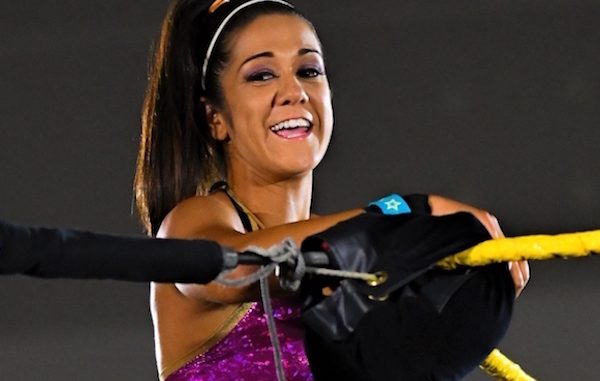
Forever: Bayley vs. Sasha Banks
(NXT Takeover Respect – October 7, 2015)
What is the greatest women’s wrestling match of all time? What is the most important women’s wrestling match of all time? A strong argument can be made that the match between Sasha Banks and Bayley at NXT Takeover: Brooklyn deserves consideration for both distinctions.
On a stacked NXT card during a major SummerSlam weekend, Banks and Bayley delivered the match with the most passion, excitement, and emotional investment of the entire weekend. Even without headlining the show, the match stole the spotlight, and in doing so, helped permanently change the way both fans and WWE management viewed women’s professional wrestling. Most importantly, the shift lasted. Future progress in women’s wrestling was built on the foundation laid by that performance in Brooklyn.
Because of the success of the first encounter, WWE wisely decided to run the match back the following month. This time, the rematch was rewarded with the main event position and a 30-minute Iron Man stipulation at NXT Takeover: Respect.
Once again, both women delivered an outstanding performance. Early in the match, Banks and Bayley attempt to outwrestle each other cleanly, relying on technique and skill. Frustration eventually pushes Sasha to escalate the intensity, resorting to cheap tactics and a nastier edge. Bayley is not the only victim of Sasha’s cruelty. In one memorable moment, Sasha steals a young fan’s hair bow and mocks her, reducing the child to tears and generating genuine heat from the audience.
Sasha’s behavior forces Bayley to fight fire with fire, but throughout the contest Bayley is constantly trying to recover and catch up. It is the perfect structure for an underdog babyface performance. The opening 25 minutes carefully establish the story and pacing that make the final five minutes so effective. Rather than filling the match with constant dramatic near falls, the wrestlers save the biggest moments for the climax. Every meaningful high spot, counter, and near submission in the closing stretch feels earned.
The final two minutes are especially masterful, with rapid transitions between submission holds and counters creating multiple peaks of excitement before Bayley finally forces Sasha to submit with only seconds remaining on the clock. The match stands as a textbook example of how to gradually escalate drama and emotion toward a true climax.
Most fans still consider the original Brooklyn encounter the superior match, and there is a valid argument for that position. However, the Iron Man rematch remains an excellent example of a rematch that justified its existence. Rather than simply repeating the formula of the first match, Banks and Bayley expanded on it, telling a different story while maintaining the same emotional investment that made their original encounter so special.
Leave a Reply
You must be logged in to post a comment.