
SPOTLIGHTED PODCAST ALERT (YOUR ARTICLE BEGINS A FEW INCHES DOWN)...
Since the pandemic, WWE has significantly reduced the number of live events on its schedule. As many wrestlers, writers, and members of management have discussed, the lighter touring schedule comes with both benefits and drawbacks.
The benefits are obvious: less wear and tear on performers’ bodies and a healthier work-life balance. The drawback is that wrestlers have fewer opportunities to refine their skills, experiment with new aspects of their characters, and gain the in-ring repetitions necessary to stay sharp. In recent weeks, WWE has returned to the road for a series of live events. Granted, this has largely been a European tour, but there have been discussions – and even some plans – regarding the expansion of WWE’s live event schedule moving forward.
Fans also lose something when live events disappear from the calendar. Early in my wrestling fandom, I was always more excited to attend a television taping. It felt more important and prestigious. However, after attending both television tapings and live events on multiple occasions, I developed a much greater appreciation for the non-televised house show live event experience.
At a live event, fans get to witness the purity of the craft without the time constraints and production demands that often affect televised wrestling. During one of my first independent wrestling shows, former WWE wrestler Mike Knox handed out a small piece of paper outlining the seven steps of professional wrestling psychology: character establishment, shine, cutoff, heat, hope spots, comeback, and finish.
Because of the many restrictions imposed by television, fans do not always get to see each of these elements fully displayed during televised matches. At live events, however, these time-tested components of wrestling psychology are often much easier to identify. Moreover, live events provide a more authentic and unfiltered view of professional wrestling. Wrestlers are able to showcase their style, timing, and in-ring craft without the need to serve broader television objectives, commercial breaks, or storyline developments. The focus is placed squarely on the match itself and the connection between the performers and the audience.
For this week’s article, I selected three non-televised WWE matches from live events. Each of these matches highlights the qualities that make live event wrestling such an enjoyable experience and demonstrates why these shows remain an important part of professional wrestling.
Then: Bret Hart vs. British Bulldog (June 1992)
In the past, house shows often served as a venue for wrestlers to gain valuable practice reps before meeting in higher-profile televised or pay-per-view matches. These live events gave performers an opportunity to work on their timing, test spots, refine transitions, and develop the chemistry necessary to deliver their best performance when the stakes were highest.
This 1992 match between Bret Hart and the British Bulldog is a perfect example of a dress rehearsal. Just weeks before their legendary encounter at SummerSlam in London, Bret Hart squared off against Davey Boy Smith at a stateside live event. What stands out immediately is the stripped-down quality of the contest.
This is an athletic wrestling match between two babyfaces, built around holds, counters, transitions, and crisp execution rather than elaborate storytelling or spectacle. Every movement feels smooth and purposeful. There are no holes in either wrestler’s game – no missed strikes, mistimed spots, or overly choreographed sequences. It is simply two elite performers showcasing the fundamentals of professional wrestling at the highest level.
The format closely mirrors what fans would later see at SummerSlam. Despite both men being fan favorites, Bret assumes the role of the match’s aggressor, controlling much of the action and subtly working from the heel position. Bulldog, meanwhile, serves as the sympathetic babyface, fighting from underneath and building toward a spirited comeback in the closing stages.
Unlike the overwhelmingly pro-Bulldog atmosphere at Wembley Stadium, this crowd is much closer to 50/50, with both competitors receiving strong reactions whenever the pace quickens and the intensity rises. As a result, the audience responds to the match much like they would a legitimate sporting contest. It is an excellent example of how pure professional wrestling, presented in a simple and straightforward manner, can be immensely entertaining.
Now: Triple H and The Shield (Dean Ambrose & Seth Rollins) vs. The Bar (Cesaro & Shemus) & Bray Wyatt (November 1st 2017)
One of the best parts about attending a live event is the feeling that the show is just for you. Storylines take a back seat and television considerations are no longer the primary focus. For one night, the wrestlers and performers are there to entertain the fans in attendance. A common tactic used by house show announcers is to advertise a “just for (insert location here)” stipulation, appearance, or bonus attraction. It creates the impression that the audience is witnessing something unique that cannot and will not be replicated elsewhere.
On Nov. 1, 2017, the fans in Scotland actually did witness something that was just for them. An illness removed Roman Reigns from the card, leaving Shield members Dean Ambrose and Seth Rollins without a third man to face the team of The Bar & Bray Wyatt. The unlikely and genuinely surprising replacement for Reigns was Triple H. To fully embrace his role as the honorary third member of The Shield, Triple H even donned Shield-style ring gear for the occasion.
If I had to describe the match in one word, it would be fun. All six competitors work hard, but the novelty of the matchup is what makes it memorable. It is fun to see Triple H square off with Bray Wyatt, and it is equally entertaining to watch Cesaro bump and feed during a classic Triple H hot-tag comeback. The match feels less like a storyline-driven television contest and more like a celebration for the fans who bought tickets to the event.
My favorite moment comes during the false finish following Triple H’s Pedigree. In the hard camera’s wide shot, you can see the entire crowd rise to its feet and surge toward the barricades in anticipation of the victory. When the pinfall is broken up, the fans collectively pull back in disbelief. It is a perfect example of how an effective false finish can draw an emotional reaction from a live audience.
The match ultimately concludes with Triple H teaming with Ambrose and Rollins to deliver The Shield’s trademark triple powerbomb. The crowd gets the happy ending it came to see, and the show closes with a memorable image that could only happen at a live event. Nearly a decade later, the match remains a fascinating wrestling curiosity – a one-night-only performance that gave Scottish fans a genuinely special experience and created a moment that will never be repeated
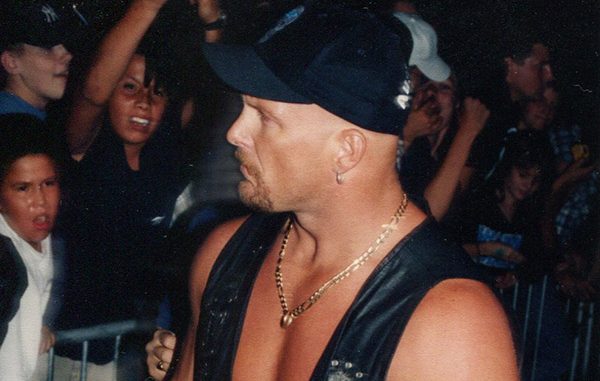
Forever: “Stone Cold” Steve Austin vs. Triple H (Mar. 13,1998)
As mentioned above, house shows traditionally served as practice reps and rehearsals for upcoming matches. In the lead-up to WrestleMania 14, Steve Austin’s scheduled opponent, Shawn Michaels, was sidelined with a serious back injury. Likewise, Triple H’s WrestleMania opponent, Owen Hart, was dealing with an ankle injury.
As a result, neither Austin nor Triple H could regularly work with their WrestleMania opponents on the live event circuit. Instead, they were frequently paired against each other at house shows leading up to WrestleMania. One such match took place in Anaheim, Calif., just two weeks before WrestleMania 14.
This contest is a classic example of the early Attitude Era WWF. The wrestlers have swagger, the fans have energy, and the entire show feels like a happening. What stands out most is the style of the match. There is an urgency and aggressiveness to everything they do. Austin and Triple H hit the ropes hard, throw their strikes with conviction, and bump with purpose. The action never feels slow, cautious, or overly choreographed. At the same time, they wrestle smart. There are no complicated transitions that could lead to mistakes, no dangerous top-rope spots, and no unnecessary high-risk bumps. This is an excellent example of how wrestlers can work hard while still protecting themselves and their opponents.
Triple H’s selling is particularly impressive throughout the match. Watch how he bumps and feeds toward the corner or the ropes after Austin’s offense. He is constantly selling himself into position for Austin’s next attack. By doing so, he maintains the momentum of the match and allows Austin’s fiery babyface offense to keep building. The finish is also picture-perfect for a house show. Austin overcomes interference from Chyna, delivers a Stunner to both Chyna and Triple H, and scores an emphatic three-count. The crowd gets a satisfying payoff, the hero stands tall, and the audience leaves happy—a textbook live event ending.
Leave a Reply
You must be logged in to post a comment.