
SPOTLIGHTED PODCAST ALERT (YOUR ARTICLE BEGINS A FEW INCHES DOWN)...
To help you add context, my Hits are ordered from best to worst. With that said, let’s move into the high points of this week’s episode, starting with the most significant moments.
HITS
MERCEDES MONÉ’S CRASH-OUT
For me, AEW’s decision to present Mercedes Moné through a vignette rather than a live segment was exactly what her character needed. The controlled setting allowed the message to land without distraction: this wasn’t about a loss, a belt, or a setback — it was about identity. Moné stepping away and framing her return as something more personal and more destructive than title pursuits finally gave her presentation real stakes.
This is the clearest character direction Moné has had in AEW so far. Instead of positioning her as a finished product who simply cycles through championships, the vignette framed her as someone unraveling, reassessing, and re-calibrating. That distinction matters. It gives her motivations depth and allows the audience to invest in the why, not just the what.
Just as importantly, the break itself feels intentional. Time away benefits Moné by resetting her presentation, and it benefits the audience by restoring anticipation. When she said she’ll be taking more than titles when she returns, it didn’t come across as branding — it felt like a promise built on absence.
MARK BRISCOE’S TNT TITLE DEFENSE
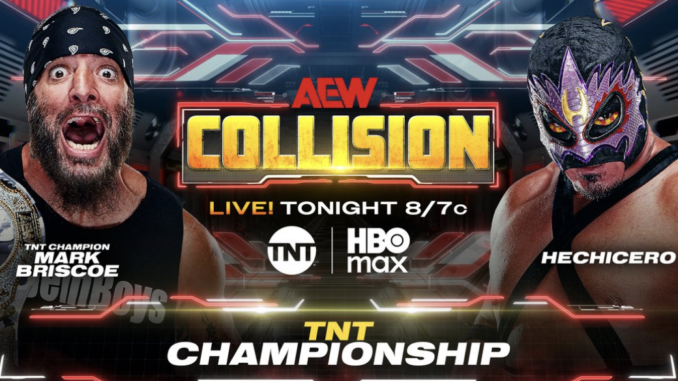
Collision has quietly become the place where Mark Briscoe feels the most himself as TNT Champion, and this defense reinforced that idea. This wasn’t about flash or excess — it was about grit, selling, and making the championship feel earned. Briscoe’s ability to look vulnerable without ever looking weak remains one of his biggest strengths, and AEW leaned fully into that here.
What stood out to me most was how deliberate everything felt. This didn’t come across like TV filler or a placeholder defense. The pacing allowed the audience to invest, and the finish reinforced Briscoe as a champion who survives fights rather than dominates them outright.
BISHOP KAUN & TOA LIONA GROWTH
The pairing of Bishop Kaun, Toa Liona, and Ricochet continues to quietly work, and this episode was another step forward. Kaun and Liona feel more defined in this role — not just as muscle, but as a presence that adds structure and credibility to Ricochet’s presentation.
Ricochet doesn’t feel overshadowed, and Kaun and Liona don’t feel like accessories. Instead, the dynamic elevates all three. Collision has increasingly become a space where wrestlers can settle into their roles, and this grouping is benefiting from that patience.
THE DEATH RIDERS SET THE TONE
Opening Collision with violence is rarely a bad idea, and the Death Riders delivered exactly that. This wasn’t chaos for chaos’ sake — it was controlled aggression, which made the group feel dangerous rather than cartoonish. Pac, in particular, continues to wrestle like someone who resents the idea of mercy, and that edge came through clearly.
AEW has flirted with positioning the Death Riders as a true identity faction rather than just another trio, and this match helped reinforce that direction. They don’t feel like they’re chasing crowd approval — they feel like they’re enforcing something.
EL CLON vs. KOMANDER
This was a reminder of how effective lucha can be when it’s presented with purpose. When the pacing is tight and the spots are allowed to breathe, the style doesn’t feel chaotic — it feels electric. The crowd was fully engaged, reacting to momentum shifts and high-risk moments rather than just waiting for a highlight reel sequence.
What really made this work was restraint. The match didn’t try to be bigger than it needed to be, and that discipline allowed the athleticism to shine. Collision benefits from these kinds of stylistic contrasts, and this was a case where the audience responded immediately because the execution matched the intent.
When lucha is done right, it’s fantastic — and this was one of those instances where it elevated the overall flow of the show rather than interrupting it.
BRODY KING STANDBY MATCH
The addition of a standby match featuring Brody King was a smart, understated choice that enhanced the show’s sports-like presentation. The result itself wasn’t the point — the value was in showing that Collision could adapt on the fly.
That flexibility made the broadcast feel less rigid and more like a live sporting event. Brody King was an ideal fit for that role, bringing immediate physical credibility without needing explanation. It wasn’t flashy, but it was effective.
MISSES
LACK OF CARD CREATIVITY
This episode suffered from a noticeable lack of structural variety. Three trios matches on the same card isn’t inherently a problem, but when two of them share nearly identical rhythms, it becomes one. Outside of the opener — which benefited from intensity and purpose — the remaining trios bouts blurred together in presentation, pacing, and crowd response.
Collision works best when it feels curated rather than assembled. Here, the repetition made portions of the show feel interchangeable instead of intentional. Trios wrestling should feel like a choice, not a default setting.
AEW’S ASSUMPTION THAT FANS ARE “BALL KNOWERS”
Since AEW announced the signings of Maya World and Hyan, the company still hasn’t done the work of telling viewers who they are. Both are clearly talented, and their inclusion is a positive step, but talent alone isn’t enough if the audience is left to fill in the gaps on their own.
AEW occasionally falls into the trap of assuming its audience already knows everyone — that fans are “ball knowers” by default. That expectation might hold for viewers who closely follow the Texas independent wrestling scene, but it’s an unfair ask of the broader audience tuning into national television.
This isn’t a criticism of Maya World or Hyan. It’s a critique of presentation. Even a brief vignette, graphic, or line of context would go a long way toward helping viewers connect. When introductions are skipped, talented wrestlers risk blending into the background through no fault of their own.
FINAL SCORE
- HITS: 6
- MISSES: 2
FINAL THOUGHTS
This was an episode of Collision where I found plenty to highlight, but not much that felt essential viewing. There were strong performances, clear character beats, and a few smart creative choices — particularly with Mercedes Moné — yet none of it rose to the level where I’d expect casual fans to go out of their way to seek this show out.
That doesn’t make it a bad episode. It makes it a functional one. Collision continues to benefit from patience and consistency, but this week leaned more toward maintenance than momentum. The highs were solid, the misses were manageable, and the overall experience felt steady rather than urgent.
WRESTLING HISTORY
On this day in 1983, in Memphis, Tennessee, Nick Bockwinkel defeated Jerry Lawler to capture the vacant AWA World Heavyweight Championship. The title had been vacated the previous month, and the match marked a rare moment where Lawler came up short in his home territory against one of the era’s most cerebral champions.
PODCAST PLUG
Be sure to check out the Collision Café I host with PWTorch’s Amin Ajani, available exclusively to PWTorch VIP members.
Did you know you can read an ad-free, silky-smooth-loading version of this website with a PWTorch VIP Membership? Also, unlock 35+ years of archives including nearly 2,000 PWTorch Weekly Newsletters dating back to the late 1980s, hundreds of retro radio shows from the 1990s, and two decades of podcasts including Post-PPV Roundtable Podcasts dating back to the mid-2000s. Plus, new VIP-exclusive articles and podcasts throughout the week, fully compatible with the native Apple Podcasts app. CLICK HERE FOR DETAILS ON VIP MEMBERSHIP
Leave a Reply
You must be logged in to post a comment.